

Key Takeaway
- A chattel mortgage is a security arrangement that uses movable property, such as a car or truck, as collateral for a loan or financing obligation.
- In vehicle financing, borrowers may continue using their vehicles while making repayments, subject to the financing agreement and applicable security requirements.
- A mortgage notation on a vehicle's Certificate of Registration (CR) indicates a recorded financing or security interest that may affect certain transactions, including vehicle sales or ownership transfers.
- After full loan repayment, borrowers may need to obtain release documents and complete the required mortgage cancellation procedures. At Asialink Finance Corporation, borrowers are notified when their documents are ready and are expected to collect them within 60 days under Asialink's current policy.
When applying for vehicle financing in the Philippines, you may encounter the term chattel mortgage in your financing agreement or vehicle registration documents. Understanding the meaning of a chattel mortgage can help you learn how a vehicle serves as collateral for financing, why a mortgage notation may appear on its Certificate of Registration (CR), and what happens after the loan is fully repaid.
This guide explains how a chattel mortgage works, how it differs from a real estate mortgage, and what borrowers should know before entering into a vehicle financing agreement.

What Is a Chattel Mortgage?
A chattel mortgage is a legal arrangement in which movable personal property is used as security for a debt or financing obligation.
In the Philippines, Act No. 1508, also known as the Chattel Mortgage Law, historically established rules for mortgaging personal property and registering these arrangements. The legal framework has since evolved through the Personal Property Security Act (PPSA).
A chattel mortgage generally involves:
- Borrower: The individual or business responsible for repaying the financing obligation.
- Creditor: The financial institution or lender holding a security interest in the asset.
- Collateral: Movable property, such as a car or truck, used to secure the obligation.
- Financing agreement: The contract outlining repayment responsibilities and applicable security conditions.
For example, a borrower may use a vehicle as security for financing while continuing to drive it, provided the terms of the agreement are followed.
However, the vehicle remains subject to the creditor's security interest until the applicable obligation has been satisfied and the required release procedures have been completed.
A chattel mortgage does not simply mean that the financing company owns the vehicle until the loan is fully paid. The rights and responsibilities of both parties depend on the financing agreement and applicable laws.
Chattel Mortgage Meaning in Vehicle Financing
In many vehicle financing arrangements, the financed vehicle serves as security for the borrower's repayment obligation.
Depending on the financing agreement, this may involve a chattel mortgage or another legally recognized personal property security arrangement.
How a Chattel Mortgage Works in Vehicle Financing
A typical arrangement may involve the following steps:
- Financing application: The buyer applies for financing to purchase an eligible vehicle.
- Credit assessment: The financing provider evaluates the applicant's qualifications, repayment capacity, and vehicle details.
- Financing agreement: The borrower reviews and signs the applicable financing and security documents.
- Security registration: The mortgage or security interest is documented and registered according to the applicable legal requirements.
- Loan repayment: The borrower continues using the vehicle while meeting the agreed repayment obligations, subject to contractual conditions.
- Mortgage release: After the loan is fully repaid, the borrower and financing provider may need to complete the required mortgage release and cancellation procedures.
The Personal Property Security Act (Republic Act No. 11057) established a legal framework for security interests in movable property.
The Land Registration Authority also began operating the electronic Personal Property Security Registry (PPSR) in February 2025, with transitional arrangements for registration procedures.
Specific requirements may therefore depend on the financing agreement, registration records, and applicable rules.
How This Relates to Asialink Vehicle Financing
At Asialink Finance Corporation, we offer financing solutions for eligible brand-new and second-hand cars and trucks, along with Car & Truck Refinancing (Sangla OR/CR).
Applicants should prepare the following basic documents:
- Completed loan application form.
- 2×2 ID picture.
- Two valid government-issued IDs.
- Latest original water, electricity, or landline bills.
- Proof of residency and documented proof of income.
Additional requirements depend on the financing product:
- Car & Truck Refinancing (Sangla OR/CR): OR/CR, recent photograph of the vehicle, and proof of Taxpayer Identification Number (TIN). Taxi and PUV applicants must also provide a franchise or permit to operate.
- Brand-New and Second-Hand Car & Truck Financing: OR/CR, offer to sell or price quotation, recent photograph of the vehicle, and proof of TIN.
Employed applicants may also need to provide a Certificate of Employment, company ID, payslips covering the previous three months, and a payroll bank account statement. Business owners may be required to submit a Mayor's Permit, DTI or SEC Registration, and other relevant business documents.
Requirements may vary depending on the financing product and applicant's circumstances. All applications are subject to documentation review, credit assessment, and approval.
How Is a Chattel Mortgage Different From a Real Estate Mortgage?
The main difference between a chattel mortgage and a real estate mortgage is the type of property used as security.
A chattel mortgage traditionally involves movable personal property, while a real estate mortgage involves immovable property such as land or buildings.
The type of collateral determines which documentation and registration procedures apply.
At Asialink, vehicle financing and refinancing products are separate from Real Estate Mortgage Loans (Sangla Titulo). Each product has specific collateral, eligibility, and documentation requirements.
What Does the Mortgage Notation on a Vehicle's CR Mean?
A mortgage annotation, mortgage notation, or financing notation on a vehicle's Certificate of Registration (CR) indicates that a security interest associated with a financing arrangement has been recorded against the vehicle.
In transactions involving a registered chattel mortgage, the CR may reflect the vehicle's encumbered status.
This information helps identify the vehicle's recorded financing arrangement.
Why Is Mortgage Notation Important?
A mortgage notation may affect certain transactions involving the vehicle while the financing obligation remains outstanding.
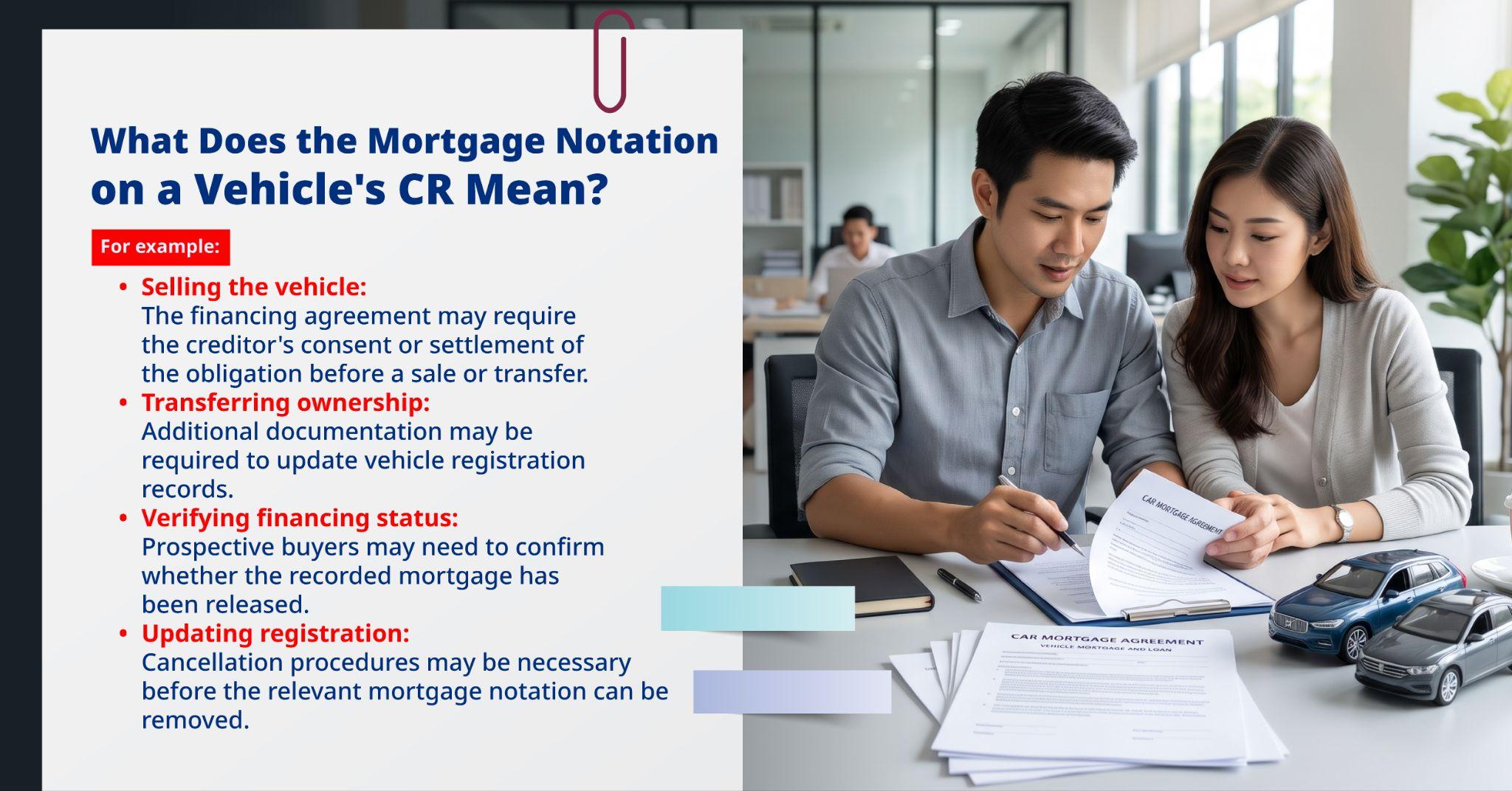
For example:
- Selling the vehicle: The financing agreement may require the creditor's consent or settlement of the obligation before a sale or transfer.
- Transferring ownership: Additional documentation may be required to update vehicle registration records.
- Verifying financing status: Prospective buyers may need to confirm whether the recorded mortgage has been released.
- Updating registration: Cancellation procedures may be necessary before the relevant mortgage notation can be removed.
The Land Transportation Office (LTO) guidelines on mortgage annotation and cancellation address the recording and cancellation of vehicle mortgage information.
A mortgage notation does not automatically indicate missed payments. It may simply reflect an existing financing arrangement secured by the vehicle.
Borrowers should review their financing agreement and verify any transaction-related restrictions with the financing provider.
Example of a Chattel Mortgage
A practical chattel mortgage example can help explain how a vehicle may be used as security for financing.
Illustrative Vehicle Financing Scenario
Suppose a buyer purchases a vehicle worth ₱800,000 and finances part of the purchase price.
In this example:
- The buyer pays ₱200,000 as a down payment.
- The remaining ₱600,000 is financed under an agreed arrangement.
- The vehicle may serve as collateral through a chattel mortgage or applicable security agreement.
- The borrower continues using the vehicle while fulfilling repayment obligations, subject to the agreement.
- After full settlement, the applicable mortgage release and cancellation procedures may be completed.
The key point is that the vehicle serves as security for the financing obligation. The arrangement does not automatically prevent the borrower from using the vehicle as long as the agreed conditions are met.
Disclaimer: This example is for illustration purposes only and does not represent an actual Asialink financing offer. Actual financing amounts, down payments, rates, fees, repayment terms, and eligibility requirements may vary.
Ano ang Chattel Mortgage?
For those looking for an explanation of chattel mortgage in Tagalog, a chattel mortgage refers to a security arrangement involving movable property, such as a vehicle, used as collateral for a loan or financing obligation.
Sa madaling salita, ang chattel mortgage ay isang uri ng mortgage o security arrangement kung saan ginagamit ang movable property, gaya ng sasakyan, bilang security para sa isang loan o financing obligation.
Sa vehicle financing, maaaring patuloy na gamitin ng borrower ang sasakyan habang binabayaran ang loan, depende sa napagkasunduang financing terms.
Gayunpaman, maaaring may nakarehistrong mortgage o financing interest sa sasakyan hanggang sa mabayaran ang obligasyon at makumpleto ang kinakailangang release o cancellation procedures.
Mahalagang maunawaan ng borrower ang repayment terms, dokumento, at mga kondisyon bago pumirma sa kasunduan.

What Happens After the Chattel Mortgage Is Fully Paid?
After a financing obligation secured by a chattel mortgage has been fully settled, additional documentary and administrative procedures may be required to release or cancel the registered mortgage.
Full repayment does not necessarily mean the mortgage notation disappears automatically from the vehicle's registration records.
The process generally involves obtaining the appropriate release documents and completing the required registration procedures.
Documents That May Be Required for Mortgage Cancellation
Depending on the transaction, the LTO may require:
- Original Certificate of Registration–Encumbered (CRE).
- Certified copy of the cancellation or release of chattel mortgage.
- Applicable Registry of Deeds documentation.
- Original Official Receipt (OR) of the relevant recording fee.
- Other supporting documents required for the specific transaction.
The exact requirements depend on the applicable registration procedure and circumstances.
Borrowers can check the LTO Citizen's Charter for documented procedures and should confirm current requirements with the appropriate office before submitting their documents.
Asialink's Collateral and Document Release Process
At Asialink Finance Corporation, we follow an established procedure for releasing collateral and related documents after full loan repayment.
Our process includes:
- Notification: Once the loan has been fully paid and the collateral and release documents are ready, we notify the borrower.
- Personal branch visit: The borrower must personally visit the designated branch where they requested to claim their collateral.
- Release coordination: The branch handling the account coordinates the release process directly with the borrower.
- Document issuance: Our branch assists with the applicable release procedures and issues the necessary release or cancellation documents.
- Registration procedures: Where required, the borrower must ensure the appropriate cancellation steps are completed with the relevant authorities.
Collecting release documents does not necessarily mean that the mortgage notation has already been cancelled on the vehicle's CR.
Document Collection Period and Applicable Fees
Under Asialink's current policy, borrowers are expected to collect their release documents within 60 days of receiving notification that the documents are ready.
If the documents remain unclaimed beyond the 60-day period and the borrower subsequently requests their retrieval or reprocessing, a ₱1,500 fee applies under our policy.
This collection period and retrieval or reprocessing fee are specific to Asialink and should not be interpreted as general LTO requirements or fees imposed by Philippine law.
Processing timelines may vary depending on document completeness and applicable procedures.
For account-specific assistance, borrowers can coordinate with their designated branch through our official branch directory.
Borrowers should also verify the current cancellation process with their financing institution, the LTO, and the Registry of Deeds, where applicable.
Why Is It Important to Understand a Chattel Mortgage Before Financing a Vehicle?
Understanding a chattel mortgage helps borrowers recognize their rights and responsibilities before entering into a vehicle financing agreement.
It is particularly useful for the following reasons:
- Identifying collateral: Borrowers understand which asset is being used as security for their financing obligation.
- Understanding registration records: Borrowers can recognize why mortgage or financing information may appear on the vehicle's CR.
- Planning vehicle transactions: Certain sales or ownership transfers may require additional steps while the mortgage remains recorded.
- Reviewing repayment responsibilities: Borrowers can examine interest charges, repayment schedules, fees, and contractual conditions before signing.
- Preparing for loan completion: Borrowers can understand the documentation and cancellation procedures that may be required after full repayment.
Before signing a financing agreement, borrowers should carefully review the terms, assess their repayment capacity, and clarify unfamiliar conditions with the financing provider.
Understanding these requirements can help borrowers manage their financing obligations and prepare for future transactions involving the vehicle.
Explore Vehicle Financing Options with Asialink
Understanding the chattel mortgage meaning is useful when comparing vehicle financing arrangements that involve movable property as security.
At Asialink Finance Corporation, we provide financing and refinancing solutions for eligible vehicle buyers and owners in the Philippines.
Our relevant financing products include:
- Auto & Truck Financing: Financing solutions for eligible brand-new and second-hand cars and trucks, subject to applicable eligibility and approval requirements.
- Car & Truck Refinancing (Sangla OR/CR): Financing secured by eligible vehicles, subject to collateral assessment, ownership verification, and documentation requirements.
Each product has its own financing purpose, eligibility criteria, and supporting documentation requirements.
Before applying, borrowers should consider their financing needs, repayment capacity, vehicle documentation, and applicable terms.
You can explore Asialink's financing products to learn more about available options, eligibility criteria, and application requirements.
All applications remain subject to credit assessment, collateral evaluation where applicable, documentary compliance, and approval.
Conclusion
Understanding what a chattel mortgage is helps borrowers recognize how movable property, particularly vehicles, may be used as security for a financing obligation.
In vehicle financing, the mortgage or security arrangement establishes certain rights and responsibilities under the agreement. A mortgage notation may appear on the vehicle's CR, and additional procedures may be necessary to cancel the recorded mortgage after full repayment.
Before entering into a financing agreement, borrowers should review their repayment obligations, documentation requirements, and applicable release procedures.
For those considering vehicle financing or refinancing, Asialink Finance Corporation offers financing solutions for qualified applicants. Our team can provide information about available products, eligibility requirements, and applicable financing conditions.
Disclaimer: Information provided is for general guidance only and should not be considered legal or financial advice. Financing arrangements, mortgage registration procedures, documentation requirements, and applicable charges may vary. Borrowers should verify current requirements with their financing institution and relevant authorities. All Asialink financing applications are subject to eligibility requirements, credit assessment, documentation review, and approval.
FAQs
Can a vehicle with an existing chattel mortgage be sold or transferred?
A vehicle subject to an existing chattel mortgage may have restrictions on its sale or transfer. Borrowers should review their financing agreement and obtain any required creditor consent or mortgage release documentation before proceeding. Relevant registration and transfer requirements should also be verified with the LTO.
Who pays the chattel mortgage registration fees in vehicle financing?
Responsibility for chattel mortgage registration fees depends on the financing agreement and applicable charges. Some arrangements may assign these expenses to the borrower. Applicants should request a breakdown of registration, documentary, and other financing-related fees before signing the agreement.
Can a chattel mortgage apply to assets other than vehicles?
Yes. Chattel mortgages have historically covered movable personal property beyond vehicles, including certain equipment and machinery. The current legal framework also includes the Personal Property Security Act, which governs security interests in movable assets. Eligibility depends on the asset, transaction, and applicable requirements.
What documents are usually related to a chattel mortgage?
Common documents may include a financing agreement, chattel mortgage or security agreement, vehicle OR/CR, registration records, and supporting documents. After full repayment, release or cancellation documents may also be required. Exact requirements depend on the financing arrangement and relevant authorities.
What happens if a borrower misses payments on a vehicle under a chattel mortgage?
Missed payments may result in charges or other consequences under the financing agreement. Continued default may lead to enforcement procedures involving the secured vehicle, subject to applicable laws. Repossession is not necessarily automatic after one missed payment. Borrowers should contact their financing provider to discuss their account.