

Key Takeaway
- A foreclosed property is real estate subject to foreclosure proceedings, usually after a borrower defaults on a loan secured by the property.
- Foreclosed properties in the Philippines can be found through official listings from banks, financing companies, asset-management companies, and authorized auction platforms.
- Before buying a foreclosed property, buyers should review the property title, ownership records, occupancy status, physical condition, outstanding obligations, and sale terms.
- Financing options depend on the asset type, buyer eligibility, and lender requirements. If you are considering a repossessed vehicle, check its condition, registration documents, and sale terms before purchasing.
Buying foreclosed properties in the Philippines can be an option for homebuyers and investors looking beyond traditional real estate listings. These properties may be offered through banks, financing companies, or public auctions, sometimes at prices different from those in the regular property market.
However, a lower asking price does not always mean a better deal. Before buying, it is important to understand the foreclosure process, verify ownership records, inspect the property's condition, and review any outstanding obligations. This guide explains what to check when evaluating foreclosed properties and repossessed vehicles in the Philippines.
Ano ang Foreclosed Property?
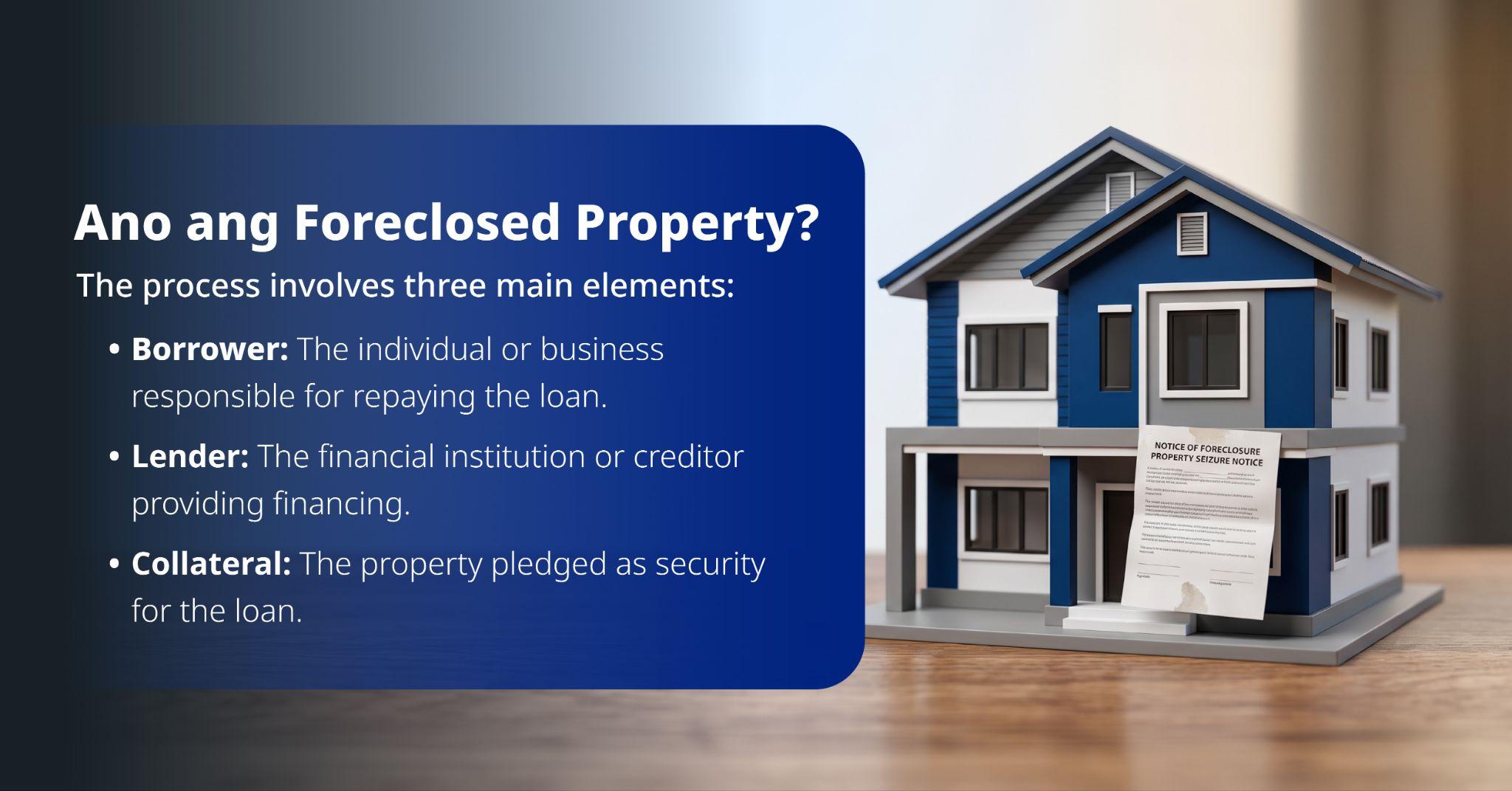
A foreclosed property is real estate subject to legal proceedings that allow a lender to enforce its rights over property used as collateral when a borrower defaults on a secured loan.
The process involves three main elements:
- Borrower: The individual or business responsible for repaying the loan.
- Lender: The financial institution or creditor providing financing.
- Collateral: The property pledged as security for the loan.
When a borrower fails to meet their repayment obligations, the lender may initiate foreclosure under the mortgage agreement and applicable Philippine laws. The property may eventually be sold at public auction or offered for sale after being acquired through the applicable legal process.
Unlike a regular property sale, which typically involves a voluntary transaction between an owner and buyer, a foreclosure-related sale may involve specific legal procedures, ownership conditions, and sale restrictions.
For those searching for Ano ang Foreclosed Property, the important distinction is that foreclosure is a legal process involving secured real estate, not simply a discounted property sale.
Why Do Properties Become Foreclosed?
Foreclosure may occur when borrowers fail to meet their repayment obligations under a loan secured by real estate.
Common circumstances include:
- Missed loan payments: A borrower fails to make payments according to the agreed repayment schedule.
- Contractual default: The borrower breaches obligations that may allow the lender to enforce its security rights.
- Enforcement of collateral rights: The lender initiates the appropriate legal process to recover the outstanding obligation.
- Property disposition: Following the required procedures, the property may be sold at auction or subsequently disposed of by an authorized owner.
In the Philippines, certain extrajudicial real estate foreclosure procedures are governed by Act No. 3135, which establishes requirements for foreclosure sales and redemption rights.
A missed payment does not automatically transfer property ownership to the lender. Foreclosure must follow the applicable financing agreement and legal requirements.
Depending on the circumstances, redemption rights or unresolved legal proceedings may also affect when a property can be transferred to a buyer.
Where Can You Find Foreclosed Properties in the Philippines?
Buyers searching for foreclosed properties in the Philippines can explore several channels offering properties acquired through foreclosure or related asset-recovery procedures.
Common sources include:
- Banks: Some banks maintain official listings of acquired or foreclosed residential and commercial properties.
- Financing companies: Certain financing providers may offer acquired assets for sale under their own procedures.
- Auction platforms: Authorized auction channels may publish available assets, bidding requirements, and schedules.
- Asset-management companies: Companies handling acquired properties may coordinate sales on behalf of authorized owners.
- Official property listings: Financial institutions may maintain dedicated webpages containing available properties and their sale conditions.
- Public auction announcements: Foreclosure notices may provide details about properties scheduled for auction.
Buyers looking for bank-foreclosed properties in the Philippines can explore acquired-property listings published by banks and other financial institutions. Before proceeding, they should confirm that the property is still available and that the listing comes from an official or authorized source.
Before contacting a seller or making a payment:
- Verify the identity of the bank, financing company, or authorized selling representative.
- Confirm that the property is available for sale.
- Request the official terms and conditions.
- Check the payment instructions and required documents.
- Avoid transferring money to unverified personal accounts.
Buyers interested in other types of acquired assets can also explore the Asialink Auction Portal and confirm the availability, documentation, and applicable sale conditions of any listed asset directly through official channels.
What Should You Check Before Buying a Foreclosed Property?
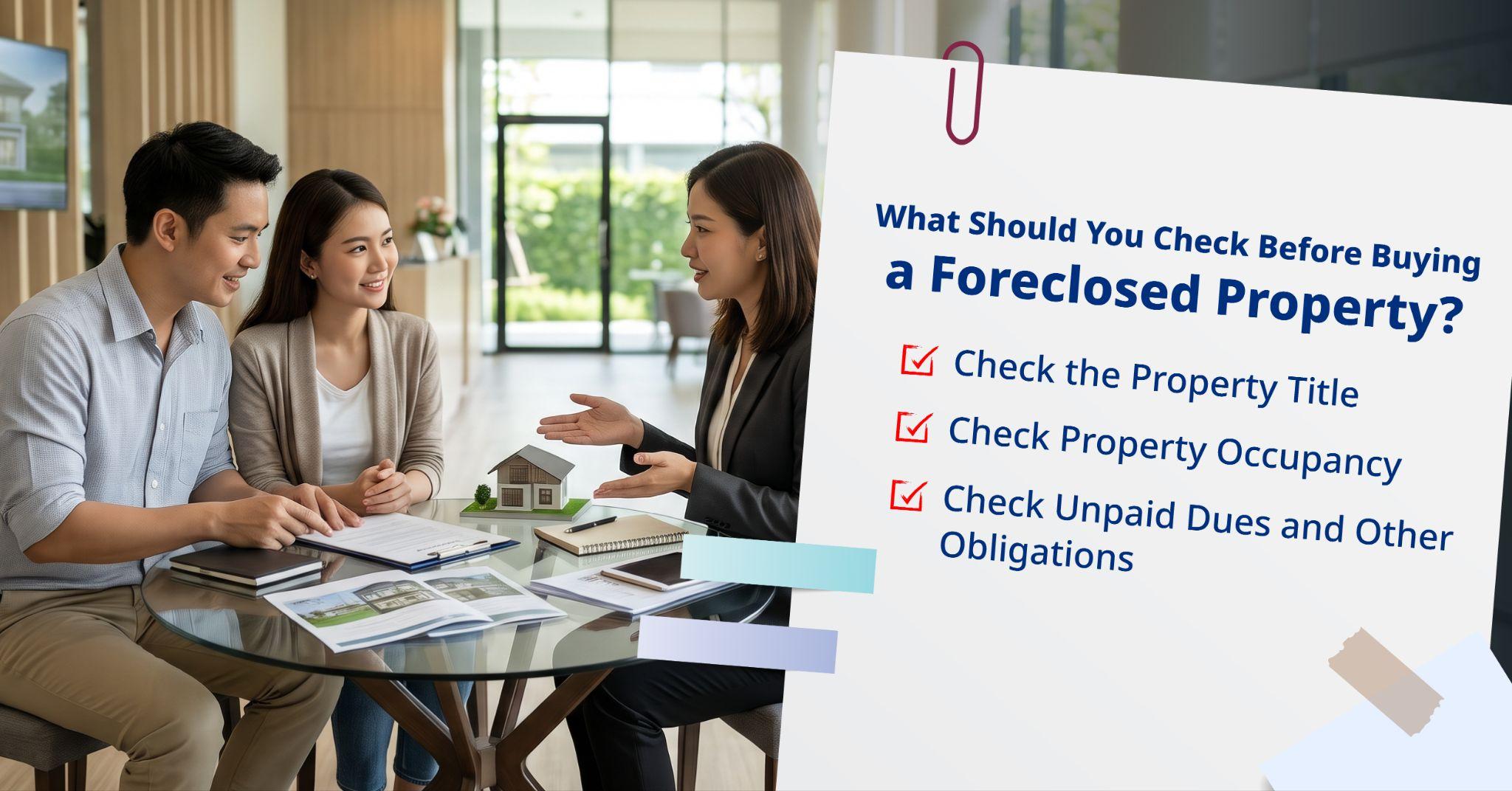
Before purchasing foreclosed real estate, buyers should evaluate three important areas: legal ownership, property occupancy, and financial obligations.
A property's asking price is only one part of the overall decision. Unresolved documentation issues or additional expenses may affect the final cost and timeline.
Check the Property Title
The property title is one of the most important documents to review before purchasing foreclosed real estate.
Buyers should verify:
- Registered owner: Confirm whose name appears on the property's current title.
- Property details: Match the lot number, location, land area, and technical description against the property being offered.
- Existing annotations: Review recorded mortgages, adverse claims, restrictions, or other relevant entries.
- Liens or encumbrances: Determine whether registered claims or obligations may affect ownership or transfer.
- Title status: Confirm that the property can be transferred under the proposed sale arrangement.
Depending on the property, relevant documents may include a Transfer Certificate of Title (TCT) or Condominium Certificate of Title (CCT).
Buyers can request a Certified True Copy of the title through the Land Registration Authority's eSerbisyo portal or coordinate with the appropriate Registry of Deeds.
However, reviewing a title copy alone does not guarantee that ownership is clear or that the property has no legal issues.
For properties involving foreclosure, buyers should also ask whether redemption rights, pending proceedings, or unresolved ownership matters could affect the sale.
Consulting a qualified real estate lawyer can help clarify these concerns before committing to a purchase.
Check Property Occupancy
Foreclosed properties are not always vacant when offered for sale.
Some may still be occupied by former owners, tenants, or other individuals, while others may be vacant but subject to unresolved possession-related issues.
Occupancy can affect when the buyer can:
- Access and inspect the property.
- Begin repairs or renovations.
- Move into or use the property.
- Complete the turnover process.
Before purchasing, buyers should ask whether the property is occupied, who is responsible for turnover, and whether any legal proceedings affect possession.
Payment and ownership transfer do not necessarily guarantee immediate physical possession. Buyers should confirm the expected turnover arrangements in the sale documents rather than assuming the property will be delivered vacant.
Check Unpaid Dues and Other Obligations
Outstanding financial obligations can affect the total cost of acquiring a foreclosed property.
Before making an offer, investigate possible unpaid charges, including:
Not every unpaid obligation automatically becomes the buyer's responsibility. The applicable law, nature of the obligation, and conditions of sale determine how these expenses are handled.
Buyers should request an itemized explanation of any known outstanding charges and verify who is responsible for settling them.
This helps avoid unexpected costs after the transaction.
What Should You Know About a Foreclosed House and Lot?
A foreclosed house and lot may be an option for buyers looking for residential properties outside the traditional real estate market. However, its condition, location, and legal status should be evaluated just as carefully as those of any other real estate purchase.
Important considerations include:
- Property condition: Inspect the roof, walls, flooring, plumbing, electrical systems, and other visible structural components.
- Location: Evaluate accessibility, transportation options, nearby services, and potential environmental risks.
- Occupancy: Confirm whether the property is vacant and when possession can be transferred.
- Title and ownership: Verify the registered owner, property description, and relevant annotations.
- Renovation requirements: Estimate necessary repairs, maintenance, and improvements.
- Outstanding obligations: Investigate applicable taxes, association dues, and other property-related charges.
- Sale restrictions: Review bidding rules, payment deadlines, inspection limitations, and other contractual conditions.
For example, a house with a relatively low purchase price may require substantial renovation expenses. Another property may have limited inspection access or unresolved occupancy issues.
To assess the potential total cost, buyers can use the following approach:
This calculation provides a more useful comparison than the advertised price alone.
A foreclosed house and lot is not automatically affordable or profitable. Its suitability depends on the property's actual condition, location, ownership status, and the buyer's intended use.
Repossessed Cars Philippines: Another Type of Recovered Asset
Apart from real estate, secured financing arrangements may also involve vehicles that are recovered when borrowers default on their loans.
Repossessed cars in the Philippines are vehicles recovered by lenders through applicable legal procedures after borrowers default on their vehicle financing obligations.
Although vehicle repossession and real estate foreclosure follow different legal processes, both involve enforcing rights associated with secured financing.
Recovered vehicles may eventually be offered for sale through:
- Financing companies' official sales channels.
- Authorized auction platforms.
- Acquired-asset listings.
- Other verified vehicle sales arrangements.
Available inventory may include passenger cars, trucks, or other vehicle categories, depending on the seller.
Unlike conventional second-hand vehicle listings, repossessed vehicles may have limited maintenance records, inspection opportunities, or specific sale conditions.
Buyers should therefore understand the seller's policies and assess the vehicle's actual condition before making an offer.
How to Evaluate Repossessed Cars Before Buying
Buying a repossessed vehicle requires more than checking its listed price or viewing photographs.
A practical evaluation should cover the following areas:
- Perform a physical inspection. Examine the exterior, interior, tires, lights, and visible structural components. Check for signs of previous damage, corrosion, or water exposure.
- Review registration documents. Request the available OR/CR and verify the registration details. Confirm any outstanding documentation or ownership-transfer requirements.
- Match vehicle identifiers. Compare the chassis or Vehicle Identification Number (VIN), engine number, and other identifying information against the available records.
- Check mileage and maintenance history. Review the odometer reading and available service records. Mileage alone does not establish a vehicle's mechanical condition.
- Assess mechanical condition. Where inspection is permitted, consider having a qualified mechanic evaluate the engine, transmission, brakes, suspension, and other major components.
- Understand auction conditions. Review inspection access, bidding requirements, payment deadlines, and the seller's specific terms.
- Confirm additional expenses. Ask about applicable transfer fees, registration expenses, administrative charges, and other buyer-payable costs.
Buyers should also confirm whether a vehicle is being sold on an as-is, where-is basis and whether any warranties or return arrangements are expressly included.
Do not assume that warranties, repairs, or returns are available unless the official sale documents specifically provide for them.
Can You Finance a Foreclosed Property Purchase?
Financing a foreclosed property purchase may be possible, but eligibility depends on the asset, financing provider, and applicable loan requirements. Not every foreclosed property qualifies for financing, so buyers should verify the eligibility of their intended purchase before proceeding.
Factors that financing providers may assess include:
- Asset type: Whether the property is eligible under the financing provider's loan program.
- Applicant qualifications: Income, repayment capacity, credit history, and overall financial standing.
- Property condition and valuation: The property's assessed value, physical condition, and eligibility.
- Ownership records: Availability and validity of property titles and supporting documents.
- Financing terms: Applicable loan amounts, interest rates, repayment periods, fees, and other charges.
Before applying, buyers should compare financing options, review the total borrowing costs, and confirm the lender's requirements to determine whether the financing arrangement suits their needs and repayment capacity.
Is Buying a Foreclosed Property Worth Considering?
Buying a foreclosed property can be worth exploring when the asset meets the buyer's requirements and the total acquisition costs are manageable.
However, buyers should evaluate both the potential advantages and the associated responsibilities.
For buyers exploring financing options, Asialink Finance Corporation offers several products for eligible applicants, including:
- Real Estate Mortgage Loan (Sangla Titulo): A secured loan that uses an eligible property title as collateral.
- Real Estate Financing: Financing for the purchase of eligible ready-for-occupancy (RFO) properties.
- Auto & Truck Financing: Financing for eligible brand-new and second-hand cars and trucks.
Each product has its own eligibility requirements, documentation, and repayment conditions. All applications are subject to assessment and approval.
Conclusion
Buying foreclosed properties in the Philippines requires careful research beyond comparing asking prices. Before making a purchase, buyers should verify property titles, occupancy status, outstanding obligations, physical condition, and applicable sale terms to better understand the potential costs and risks.
The same considerations apply to repossessed vehicles, where registration documents, vehicle condition, and auction requirements should be carefully reviewed before making a decision.
For buyers exploring financing options, Asialink Finance Corporation offers real estate and vehicle financing solutions for eligible applicants, subject to applicable product requirements and credit assessment. If you are considering financing an eligible property or vehicle purchase, contact Asialink to learn more about its financing options, eligibility requirements, and application process.
Disclaimer: Information provided is for general guidance only and should not be considered legal, financial, or investment advice. Property availability, ownership status, sale conditions, and financing eligibility may vary. Buyers should verify relevant details with authorized sellers and seek professional advice when necessary. All financing applications are subject to Asialink Finance Corporation's eligibility requirements, credit assessment, and approval.
FAQs
Are foreclosed properties sold as-is in the Philippines?
Many foreclosed properties are offered on an as-is, where-is basis, meaning buyers may accept the property's existing condition under the agreed sale terms. However, conditions vary by seller and transaction. Review the official sale documents, inspection arrangements, and any stated warranties or limitations before purchasing.
Can foreigners buy foreclosed properties in the Philippines?
Foreigners are generally restricted from owning private land in the Philippines under Article XII of the Philippine Constitution. However, eligible foreigners may purchase certain condominium units, subject to the ownership restrictions under Republic Act No. 4726. Foreclosure does not remove these restrictions. Buyers should obtain legal advice before proceeding.
How long does it take to buy a foreclosed property?
There is no fixed timeline. The process depends on the seller's requirements, payment arrangements, ownership documentation, title transfer, and possible occupancy or legal issues. Auction procedures and financing assessments may also affect the schedule. Buyers should confirm the expected steps and deadlines before committing.
Can you negotiate the price of a foreclosed property?
Negotiation may be possible for certain properties offered through direct sales, depending on the seller's policies. However, public auctions generally follow established bidding procedures, and the final price depends on the applicable auction rules. Buyers should verify whether offers or price negotiations are permitted.
What additional costs should buyers prepare for when purchasing a foreclosed property?
Additional expenses may include applicable taxes, documentary stamp tax, transfer and registration fees, administrative charges, renovation costs, and buyer-payable outstanding obligations. The responsibility for each expense depends on the transaction and sale agreement. Buyers should request a detailed cost breakdown before finalizing their purchase.