

Key Takeaway
- A car deed of sale records the transaction between a buyer and seller, including their details, vehicle information, and agreed purchase price.
- A completed, properly notarized deed helps support the LTO ownership transfer process, while an open deed of sale can create risks for both parties.
- Before buying a used car, check the OR/CR, verify ownership details, and confirm whether the vehicle has an outstanding loan or chattel mortgage.
You’ve found a used car that fits your budget, or you’re ready to sell your vehicle. Before handing over the keys or making a payment, there’s one important question: What documents do you need to complete the sale and transfer ownership?
A car deed of sale helps record the agreement between the buyer and seller, including the vehicle details and agreed selling price. Understanding this document can help you avoid problems later.
In this guide, learn what a car deed of sale should include in the Philippines, see a simple sample, understand open deed risks, and explore LTO ownership transfer steps.

What Is a Deed of Sale for a Car?
A car deed of sale is a written document that records the sale of a vehicle between a buyer and a seller. In the Philippines, it typically includes the names of both parties, vehicle details, selling price, date of sale, and signatures.
It serves as proof of the transaction and supports the LTO transfer of ownership process.
Why Do Buyers and Sellers Need a Deed of Sale?
A deed of sale provides proof of the vehicle transaction and helps prevent disputes over the selling price, ownership, and agreed terms.
For buyers, it supports the ownership transfer process. For sellers, it documents the sale and identifies the new buyer.
Is a Deed of Sale the Same as a Vehicle Registration?
No. A deed of sale records the vehicle purchase, while the Certificate of Registration (CR) contains the vehicle's registered information.
Signing a deed of sale does not automatically update LTO records. The buyer must complete the LTO transfer of ownership requirements to register the vehicle under their name.
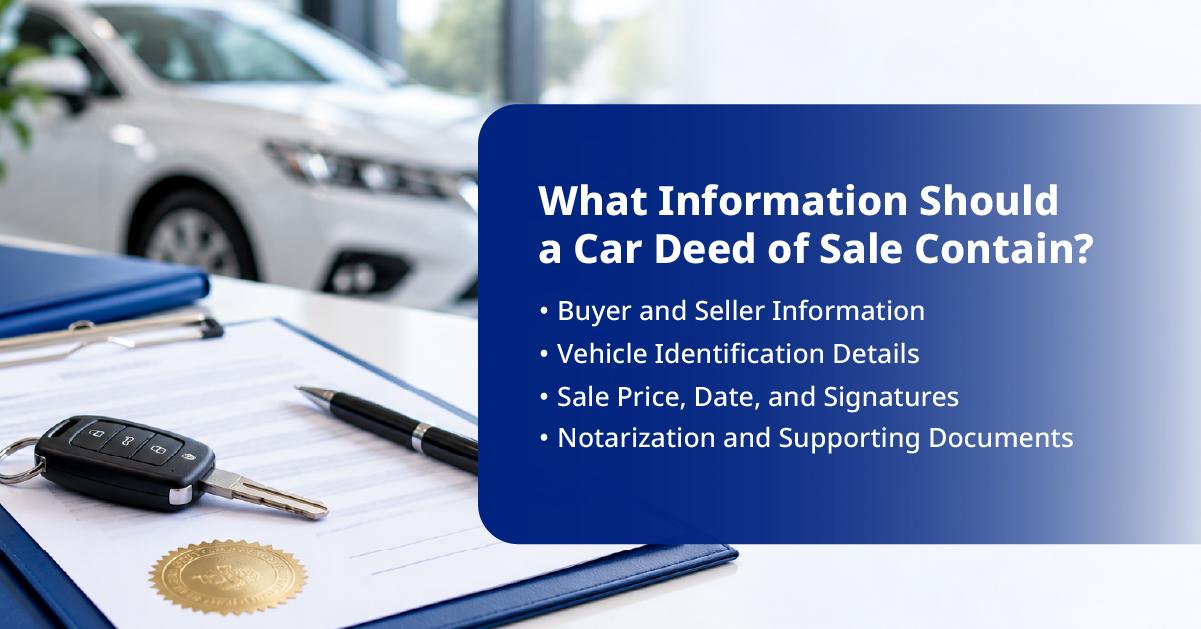
What Information Should a Car Deed of Sale Contain?
A car deed of sale in the Philippines should include accurate information about the buyer, seller, vehicle, and agreed sale. These details should match the vehicle's Certificate of Registration (CR) and supporting documents to help avoid problems during the LTO ownership transfer process.
Buyer and Seller Information
Include the following details for both parties:
- Full legal names and complete addresses
- Valid government-issued ID details
- Signatures of the buyer and seller
Make sure the information matches their identification documents.
Vehicle Identification Details
The deed of sale should identify the vehicle using details from its Certificate of Registration (CR), including:
- Plate number
- Engine number and chassis number
- Vehicle make, model, and year
Check these details carefully to avoid errors during ownership transfer.
Sale Price, Date, and Signatures
Include the agreed selling price, actual date of sale, and signatures of both parties. If payment has been received, the document may also acknowledge the payment.
Both parties should review the terms before signing.
Notarization and Supporting Documents
A notarized deed of sale is generally required for LTO ownership transfer. Both parties should complete the document and have it properly notarized by a qualified notary public.
Prepare supporting documents, including the vehicle's OR/CR and required identification, for the transfer process.
Open Deed of Sale vs Notarized Deed of Sale
An open deed of sale has missing buyer or transaction details, while a notarized deed of sale is a document formally acknowledged before a notary public. However, notarization does not make an incomplete or improperly executed deed valid.
What Is an Open Deed of Sale for a Car?
An open deed of sale is a document that may already contain the seller's signature but leaves the buyer's name or other details blank.
It sometimes appears in used-car transactions, particularly when vehicles are resold without completing the ownership transfer.
Why Can an Open Deed of Sale Be Risky?
An incomplete deed can create problems for both parties.
- Risks for the Buyer
- Difficulty verifying the seller's identity and ownership
- Possible ownership disputes
- Problems completing the LTO transfer of ownership
- Risks for the Seller
- Remaining listed as the registered owner in LTO records
- Possible questions or disputes involving the vehicle after the sale
What Should You Do If You Receive an Open Deed?
If you receive an open deed of sale, do not fill in missing details without proper authorization.
Contact the registered owner and other relevant parties to verify the transaction and arrange for a complete, properly executed, and notarized deed of sale.
If the seller is not the registered owner or the ownership history is unclear, consult the LTO or a qualified legal professional before proceeding.
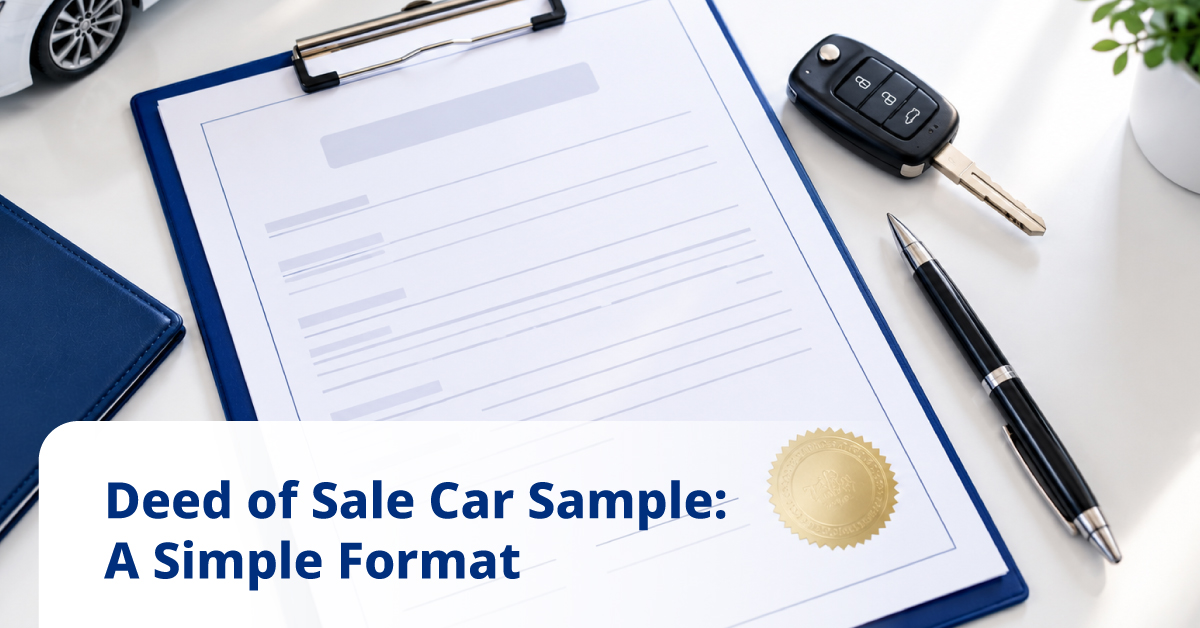
Deed of Sale Car Sample: A Simple Format
A car deed of sale sample can help you understand what information to prepare when buying or selling a vehicle in the Philippines. The example below is for educational purposes only and is not an official legal form.
Sample Vehicle Deed of Sale Layout
Seller's Full Name: [Full Legal Name]
Buyer's Full Name: [Full Legal Name]
Vehicle Details:
- Make / Model / Year: [Vehicle Information]
- Plate Number: [Plate Number]
- Engine Number: [Engine Number]
- Chassis Number: [Chassis Number]
Agreed Selling Price: PHP [Amount]
Date of Sale: [Actual Transaction Date]
Payment and Delivery Terms: [Agreed Terms]
Seller's Signature: [Signature]
Buyer's Signature: [Signature]
Notarial Acknowledgment: [To Be Completed by a Qualified Notary Public]
Note: This sample shows a basic layout only. It is not a ready-to-sign document and may not include all legal requirements.
How to Check the Sample Before Signing
Before signing a car deed of sale, review the following details to make sure they match the identification and vehicle documents:
- Seller's full legal name – Verify against a valid government-issued ID.
- Buyer's full legal name – Confirm it matches the buyer's valid ID.
- Vehicle make, model, and year – Check against the Certificate of Registration (CR).
- Plate, engine, and chassis numbers – Ensure all numbers match the vehicle records.
- Agreed purchase price – Confirm the amount agreed upon by both parties.
- Actual transaction date – Record the correct date of sale.
- Payment and delivery terms – Review the agreed payment method and vehicle handover conditions.
- Seller's and buyer's signatures – Ensure both parties sign the completed document.
- Notarial acknowledgment – Have the document properly notarized by a qualified notary public.
Important: Consult a qualified notary public or legal professional to ensure the final document is properly prepared before proceeding with the LTO transfer of ownership.
How to Transfer Car Ownership in the Philippines
After buying a used car, the deed of sale is only one part of the ownership transfer process. The seller must follow applicable sale reporting rules, while the buyer must complete the transfer with the Land Transportation Office (LTO) to update the vehicle's registration records.
Documents Needed for LTO Transfer of Ownership
Prepare the following documents, as applicable:
- Notarized deed of sale – Records the completed vehicle transaction.
- Original OR/CR – Provides the vehicle's registration and payment records.
- Valid government-issued IDs – Identifies the buyer and seller.
- PNP-HPG Motor Vehicle Clearance – Supports vehicle verification.
- Motor Vehicle Inspection Report – Records the required vehicle inspection.
- Insurance Certificate of Cover – Provides proof of the required third-party liability insurance.
- Additional documents – May be required for financed vehicles, vehicles with an existing loan or mortgage annotation, or special-case vehicles.
Confirm the complete requirements with the LTO before submitting your application.
Step-by-Step Car Ownership Transfer
- Verify the vehicle's records and ownership. Check the OR/CR, seller's identification, and vehicle details.
- Complete and notarize the deed of sale. Make sure all information matches the actual transaction.
- Complete the seller's reporting requirements. Follow applicable LTO rules and secure the necessary vehicle clearances.
- Prepare the supporting documents. Obtain the required inspection report, insurance certificate, and identification records.
- Submit the transfer application. Visit an authorized LTO office with the completed documents.
- Pay the official charges and check the updated registration. Confirm that the new Certificate of Registration reflects the buyer's name.
How Long Does the Ownership Transfer Take?
LTO filing deadlines and processing times are different. Filing deadlines determine when the sale must be reported and the ownership transfer completed, while processing times depend on document completeness, vehicle verification, and LTO procedures.
Because reporting and transfer requirements may be affected by updated regulations and implementation guidelines, buyers and sellers should confirm the applicable deadlines and requirements directly with the LTO before proceeding.
For the latest requirements, visit the official LTO website or contact an authorized LTO office.

What Happens to the OR/CR After a Car Sale?
The Official Receipt (OR) serves as proof of vehicle registration payment, while the Certificate of Registration (CR) contains the vehicle's registered details.
After a car sale, the buyer must complete the LTO transfer of ownership to update the registration records under the new owner's name.
What Should Buyers Check on the OR/CR?
Before buying a used car, verify these details:
- Registered owner's name – Check that it matches the seller's identity or supporting ownership documents.
- Plate number – Confirm it matches the vehicle.
- Engine number – Compare it with the number on the vehicle.
- Chassis number – Check that it matches the vehicle's identification details.
- Encumbrance notation – Check whether the vehicle has a recorded loan or other claim that needs to be resolved.
If any details do not match, contact the LTO for verification before proceeding.
Does a Notarized Deed Automatically Change the CR?
No. A notarized deed of sale does not automatically transfer the vehicle's registration.
The buyer must complete the LTO ownership transfer process and obtain updated registration documents reflecting the new registered owner.
What If the Car Has an Outstanding Loan or Chattel Mortgage?
A car with an outstanding loan or chattel mortgage may have existing financial obligations secured by the vehicle. A mortgage or financing notation on the Certificate of Registration (CR) may indicate that the vehicle is subject to a registered mortgage.
Before buying, review the vehicle's registration documents and confirm whether any outstanding loan or mortgage must be settled or otherwise resolved before ownership can be transferred.
How to Check If a Car Has an Existing Loan?
Review the vehicle's Certificate of Registration (CR) for an mortgage encumbrance notation.
If the car is financed or previously financed, ask the seller for supporting documents and confirm the loan status with the lender through an authorized process.
Do not assume the loan is fully paid simply because the seller says it has been settled.
What Documents May Be Needed After Loan Settlement?
After the loan has been fully repaid, the borrower should coordinate with the lender to obtain the applicable mortgage release or cancellation documents.
These documents are separate from the deed of sale and may be required to update the vehicle's registration records before completing the ownership transfer.
The specific procedures and documentation requirements should be confirmed with the lender and LTO.
Common Deed of Sale Mistakes to Avoid
Mistakes in a car deed of sale can lead to disputes or delays in the LTO transfer of ownership. Common issues include:
- Incorrect vehicle details – Plate, engine, or chassis numbers that do not match the CR.
- Blank buyer information – Leaving names or other important details incomplete.
- Unverified signatures – Signing without confirming the identity of both parties.
- Missing payment terms – Failing to record the agreed price and payment conditions.
- Incomplete ownership transfer – Not updating the vehicle's registration with the LTO.
What Should You Double-Check Before Signing?
Before signing, make sure:
- Buyer and seller names match their valid IDs.
- Vehicle details match the CR and the actual vehicle.
- Selling price and payment terms reflect the agreement.
- Transaction date and signatures are complete and accurate.
- Encumbrance details are checked, including any outstanding loan or chattel mortgage.
Review all information before signing and complete the required LTO ownership transfer process after the sale.
Conclusion
A car deed of sale is an important document when buying or selling a used vehicle in the Philippines. Before completing the transaction, make sure the buyer and seller details, vehicle information, selling price, and signatures are accurate.
Check the OR/CR, confirm any outstanding loans, and complete the LTO transfer of ownership to avoid future problems.
If you're planning to purchase a vehicle or explore financing options using an existing eligible vehicle, Asialink Finance Corporation offers Auto & Truck Financing for qualified vehicle buyers and Sangla OR/CR (Car & Truck Refinancing) for eligible vehicle owners.
Before applying, review the product-specific eligibility requirements, ownership documents, collateral conditions, financing costs, and repayment terms. All financing applications remain subject to credit assessment, collateral evaluation, and approval.
FAQs
What documents are required for LTO ownership transfer?
You generally need a notarized deed of sale, original OR/CR, valid IDs, PNP-HPG clearance, vehicle inspection report, and proof of required insurance. Additional documents may apply to financed vehicles or vehicles with an existing loan or mortgage annotation. Confirm the latest requirements with the LTO before applying.
How long does car ownership transfer take?
LTO ownership transfer processing time varies depending on document completeness, vehicle verification, and office procedures. Filing deadlines are separate from processing time. Check the current LTO requirements and deadlines to avoid delays or possible penalties during the ownership transfer process.
Can I sell a car if the CR is not in my name?
Selling a car when the CR is not in your name may create ownership and documentation problems. You must establish your legal authority to sell the vehicle. Verify the ownership records and required documents with the LTO before proceeding.
Who is responsible for transferring car ownership?
The buyer is generally responsible for completing the LTO ownership transfer, while the seller must meet applicable sale reporting requirements. Both parties should provide accurate documents and cooperate throughout the process to ensure the vehicle's registration records are properly updated.
What happens if the buyer does not transfer the car?
If the buyer fails to complete the LTO ownership transfer, the seller may remain listed as the registered owner. This can create disputes or complications involving the vehicle. Both parties should follow applicable reporting requirements and confirm registration updates.