
Second-Hand Car Loan Philippines: A Practical Buyer’s Guide

Key Takeaway
- Second-hand car financing allows eligible buyers to finance a pre-owned vehicle rather than paying the full purchase price upfront.
- Vehicle age, condition, documentation, and appraisal may affect financing eligibility.
- Buyers should inspect both the physical vehicle and its OR/CR and service records before proceeding.
- Loan approval, amount, rates, and terms depend on the financing provider’s assessment and current product requirements.
Buying a pre-owned car can help you find a vehicle that fits your needs and budget, but there’s more to consider than the price tag. Before applying for financing, it’s important to check the vehicle’s age, condition, appraisal value, OR/CR documents, and maintenance history. These details can affect both your purchase decision and financing eligibility.
Learn how second-hand car loans in the Philippines work, including loan requirements, vehicle appraisal, age limits, and what to check before applying for financing. If you’re exploring pre owned cars philippines listings, this guide will help you understand what to check, compare financing options, and make an informed decision before committing to a purchase.
What Is Second-Hand Car Financing?
Second-Hand Car Financing helps you purchase a pre-owned vehicle without paying the full price upfront. You choose a used car, apply for financing, and the lender assesses both your financial situation and the vehicle’s eligibility.
If approved, the financing covers an agreed portion of the purchase price, and you repay the borrowed amount through scheduled payments, including applicable interest and fees.
Keep in mind that approval depends on more than your income or credit history. The lender may also review the vehicle’s age, condition, documents, and appraised value before making a decision.
How Is Used Car Financing Different From Brand-New Car Financing?
The main difference is that used cars have a history of ownership and usage, which can affect how lenders assess them.
Here are a few factors to consider:
- Vehicle Condition: Used cars may have different levels of wear, repairs, and maintenance.
- Vehicle Age: Some lenders set age limits or other eligibility requirements for pre-owned vehicles.
- Market Value: A vehicle appraisal may be needed to determine its current value.
- Vehicle Documents: The Official Receipt (OR), Certificate of Registration (CR), and ownership records may require additional verification.
- Service History: Maintenance records can help assess the vehicle’s condition and identify potential concerns.
Used car financing isn’t automatically more expensive or harder to qualify for than brand-new car financing. Requirements, costs, and approval decisions depend on the lender, the vehicle, and your financial assessment.
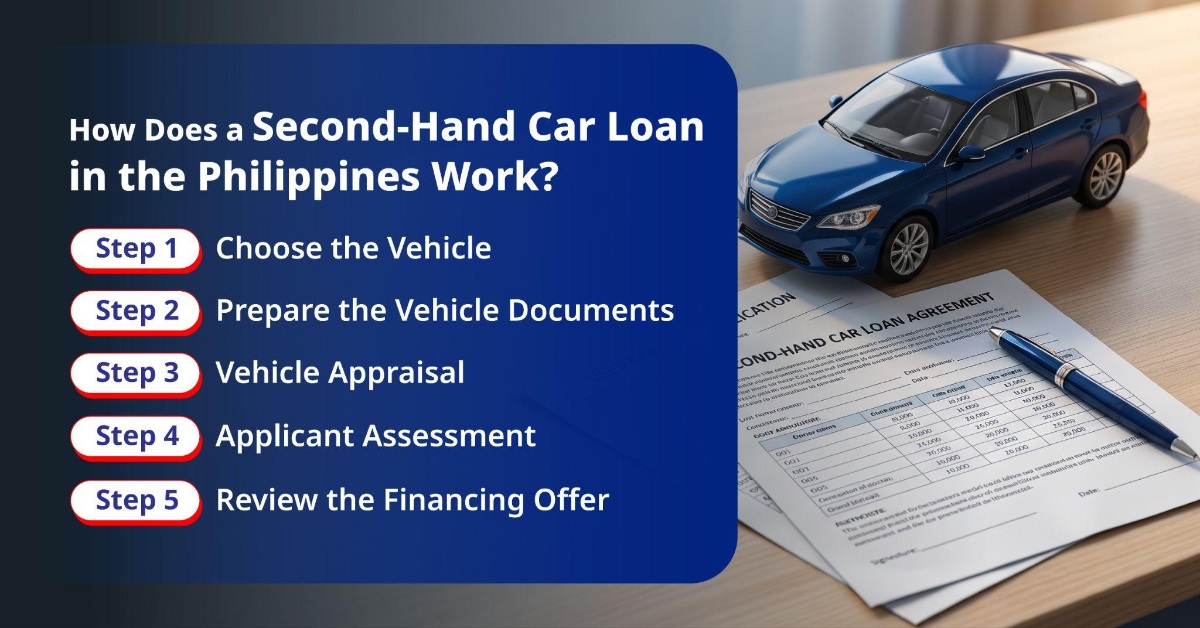
How Does a Second-Hand Car Loan in the Philippines Work?
Applying for a second-hand car loan in the Philippines involves more than choosing a vehicle and submitting an application. Lenders typically review both your financial situation and the car’s condition, value, and documents before making a financing decision.
The process generally includes choosing a used car, preparing documents, submitting your application, completing a vehicle appraisal and applicant assessment, and reviewing the financing terms before signing an agreement. The order of these steps may vary by lender.
Step 1 — Choose the Vehicle
Start by finding a used car that matches your needs and budget. Before applying for financing, check these key details:
- Make and Model: The vehicle’s brand and specific model.
- Year Model: The vehicle’s age, which may affect financing eligibility.
- Selling Price: The seller’s asking price and how it compares with similar vehicles.
- Mileage: The distance the car has traveled, which can indicate usage.
- General Condition: Check for visible damage, signs of wear, and possible mechanical issues.
Inspect the vehicle before committing to a purchase. If possible, have a qualified mechanic check its condition to help identify potential repair costs.
Step 2 — Prepare the Vehicle Documents
Having the right documents helps lenders verify the vehicle’s details and ownership before assessing your financing application.
Common documents may include:
- Official Receipt and Certificate of Registration (OR/CR)
- Offer to Sell or Price Quotation
- Latest Vehicle Photo
- Proof of Taxpayer Identification Number (TIN)
- Vehicle Information: Make, model, year, and other identifying details.
- Seller Documents: Proof of ownership or other supporting records, when required.
Document requirements may vary by financing product and transaction. Confirm the complete checklist before applying.
Step 3 — Vehicle Appraisal
A vehicle appraisal helps the lender estimate the used car’s current market value and assess its suitability for financing.
Factors may include:
- Make, Model, and Vehicle Type: The car’s specifications and market demand.
- Year Model: The vehicle’s age and depreciation.
- Mileage: The vehicle’s recorded usage, which may affect its value.
- Physical Condition: Wear, dents, scratches, and overall condition.
- Accident or Repair History: Previous damage or repairs that may affect financing eligibility.
- Market Value: Available pricing information for comparable vehicles.
- Documentation: Vehicle registration and supporting ownership records.
An appraisal does not guarantee a financing amount or approval. The final decision depends on both the vehicle and applicant assessment.
Step 4 — Applicant Assessment
After reviewing the vehicle, the financing provider evaluates whether you meet its borrowing requirements.
This assessment may include:
- Income: Your regular earnings and financial resources.
- Repayment Capacity: Your ability to manage scheduled payments alongside existing expenses.
- Submitted Documents: Identification, income records, and other required information.
- Applicant Eligibility: Whether you meet the lender’s financing criteria.
- Vehicle Details: The appraisal results and supporting documents.
- Product Requirements: Additional conditions specific to the financing arrangement.
A vehicle that meets the lender’s appraisal requirements does not automatically qualify you for financing. Approval depends on the overall assessment of your application.
Step 5 — Review the Financing Offer
If your application is approved, take time to understand the financing costs, repayment responsibilities, and agreement terms before accepting the offer.
Important details to review include:
- Approved Financing Amount: The amount the lender agrees to finance.
- Down Payment: Any amount you need to pay upfront.
- Interest Rate: The rate applicable to your financing arrangement.
- Fees and Charges: Any applicable financing, documentation, or other charges.
- Loan Term: The agreed repayment period.
- Monthly Payments: The amount you are expected to pay according to the schedule.
- Total Repayment Cost: The overall amount payable under the agreement.
- Late-Payment Terms: Potential charges and consequences of missed payments.
- Collateral Conditions: The lender’s rights and your responsibilities involving the financed vehicle.
For Asialink Second-Hand Car Financing, interest rates and financing amounts depend on factors such as your financial profile and the vehicle assessment. The applicable terms and charges should be confirmed through the official financing offer.
Once you’re comfortable with the terms, complete the required purchase and financing documents according to the lender’s instructions.
Before signing, review the full agreement and ask about anything you don’t understand. This helps you plan your repayments and understand the responsibilities that come with financing a used car.
What Vehicle Age Is Accepted for Second-Hand Car Financing?
Vehicle age is an important factor in second-hand car financing, but the accepted year model can vary depending on the lender and financing product. Older vehicles may have lower market values, more wear and tear, and different maintenance needs, which can affect their appraisal and the lender’s financing assessment.
When reviewing a used car, lenders may consider its year model, mileage, overall condition, and current market value to determine whether it meets their requirements. For Asialink Finance Second-Hand Car Financing, it’s best to confirm the eligible vehicle age or year model directly with an Asialink representative before applying.
Meeting the vehicle age requirements does not guarantee financing approval. The decision also depends on the vehicle appraisal, applicant eligibility, repayment capacity, and applicable financing terms.
What Can Affect a Used Car Appraisal?
Understanding these factors can help you evaluate a pre-owned vehicle and prepare for the financing process.
Year Model
A car’s year model can influence its market value, as vehicles generally lose value over time. However, an older car isn’t necessarily in worse condition than a newer one.
Lenders may consider the vehicle’s age alongside its maintenance history, overall condition, and market demand when determining its appraised value.
Mileage
Mileage shows how far a vehicle has traveled and provides useful information about its previous usage. Higher mileage may indicate more wear, but it doesn’t always mean the car has been poorly maintained.
It’s important to consider mileage together with the vehicle’s age, service records, and condition, rather than relying on the odometer reading alone.
Physical and Mechanical Condition
A vehicle’s physical and mechanical condition can affect its appraised value. During an inspection, important areas to check include:
- Body and Interior: Dents, scratches, rust, upholstery, and visible damage.
- Tires: Tread condition, uneven wear, and signs of damage.
- Engine and Transmission: Unusual noises, leaks, and shifting performance.
- Suspension: Signs of wear, unusual sounds, or handling problems.
- Electrical Systems: Lights, air conditioning, dashboard indicators, and other electronic features.
A visual inspection alone cannot confirm a car’s mechanical reliability. Consider having a qualified mechanic inspect the vehicle before purchasing it, especially if you notice potential issues.
Accident and Repair History
Previous accidents or repairs may affect a used car’s financing eligibility, depending on the extent of the damage, the quality of repairs, the vehicle’s current condition, and the lender’s assessment criteria.
Ask the seller for maintenance records, repair receipts, and information about previous accidents. These details can help you identify potential concerns and understand future maintenance needs.
Remember, a vehicle’s appraised value is only one part of the financing assessment. Approval also depends on your eligibility, repayment capacity, and the lender’s requirements.
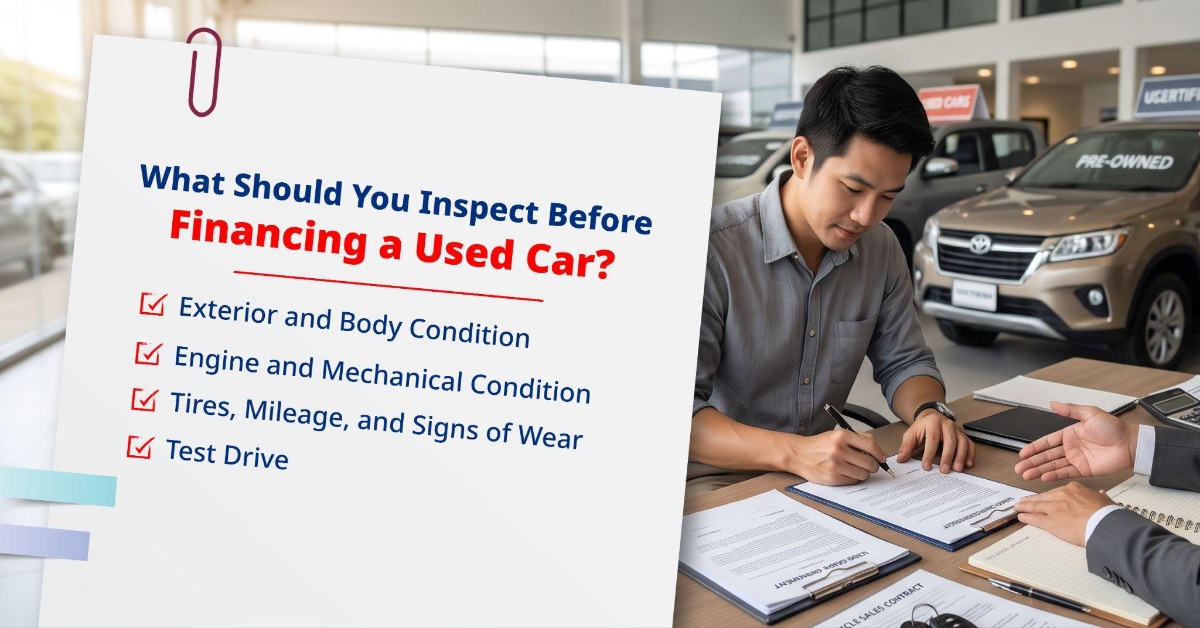
What Should You Inspect Before Financing a Used Car?
Before applying for used car financing, take time to inspect the vehicle and review its documents. A car may look well-maintained on the outside, but hidden mechanical issues or incomplete ownership records could lead to unexpected costs.
Use this pre-purchase inspection checklist to identify potential concerns before making a decision.
Exterior and Body Condition
Start by checking the car’s exterior for signs of damage or previous repairs. Look for:
- Paint Consistency: Uneven paint colors or finishes that may suggest repainting.
- Rust and Corrosion: Rust around doors, wheel arches, and underneath the vehicle.
- Panel Gaps: Uneven spacing between doors, the hood, and body panels.
- Dents and Repairs: Visible dents, scratches, or signs of major bodywork.
- Windshield and Lights: Cracks, damage, or lights that aren’t working properly.
Unusual paint differences, uneven panels, or visible repairs may warrant further inspection, especially if the seller hasn’t disclosed previous damage.
Engine and Mechanical Condition
A car’s mechanical condition can affect both its reliability and future maintenance costs. Pay attention to:
- Engine Noise: Unusual knocking, rattling, or other unexpected sounds.
- Fluid Leaks: Signs of oil, coolant, or other fluid leaks.
- Warning Lights: Dashboard alerts that remain on or appear while driving.
- Transmission: Delayed gear changes, slipping, or unusual shifting.
- Brakes: Unusual sounds, vibrations, or changes in braking response.
- Suspension: Excessive bouncing, unusual noises, or uneven handling.
Consider having a qualified mechanic inspect the vehicle before purchasing it. Some problems may not be visible during a basic inspection.
Tires, Mileage, and Signs of Wear
Mileage can tell you how much a car has been driven, but it should be considered alongside its age, maintenance history, and overall condition.
Compare the following:
- Odometer Reading: Check the recorded mileage against available service records.
- Tire Wear: Look for uneven tread wear or signs of damage.
- Interior Condition: Check the seats, dashboard, and upholstery for excessive wear.
- Pedals and Steering Wheel: Notice whether their condition appears consistent with the vehicle’s reported usage.
- Overall Condition: Compare visible wear with the car’s age and maintenance records.
Unusual differences between the mileage and visible wear may deserve further investigation. Ask the seller for supporting maintenance records when available.
Test Drive
A test drive can help you understand how the car performs under normal driving conditions. With the seller’s permission, pay attention to:
- Steering: Check for pulling, unusual resistance, or difficulty controlling the vehicle.
- Brakes: Notice how smoothly and consistently the car slows down.
- Transmission: Check whether gear changes feel smooth and responsive.
- Suspension: Listen for unusual sounds when driving over uneven surfaces.
- Warning Lights: Watch for dashboard alerts during the drive.
- Vibrations: Notice unexpected shaking or noises while accelerating or braking.
A successful test drive doesn’t guarantee that a vehicle has no hidden problems. A professional inspection can help identify issues that may not appear during a short drive.
Why Should You Check the OR/CR Before Financing?
Before financing a used car in the Philippines, it’s important to check the Official Receipt (OR) and Certificate of Registration (CR). These documents help you check the vehicle’s registration details, identify the registered owner, and compare the recorded information with the actual vehicle. Additional ownership and legal checks may still be necessary.
Reviewing the OR/CR can help you spot incorrect details, ownership concerns, or existing loan-related restrictions before committing to a purchase. However, these documents alone cannot confirm that a vehicle is free from all legal or ownership issues.
Match the OR/CR With the Actual Vehicle
Start by comparing the information on the OR/CR with the vehicle you’re planning to buy. Check the following:
- Engine Number: Confirm that it matches the number recorded on the vehicle.
- Chassis Number: Compare the number on the registration documents with the vehicle’s identification markings.
- Make and Model: Make sure the listed vehicle details are accurate.
- Plate and Registration Details: Check that the plate number and other registration information match the vehicle’s records.
If any information doesn’t match, ask the seller for an explanation and supporting documents before proceeding with financing.
Check the Registered Owner
The registered owner’s name on the CR should be compared with the seller’s identity.
If the seller isn’t the registered owner, ask for documents showing their authority to sell the vehicle, such as an applicable deed of sale or written authorization.
Don’t assume that possession of the OR/CR proves the seller has the right to sell the car. Verify the ownership details and required transfer documents before making a payment.
Check for Existing Loans or Claims on the Vehicle
A used car may still be linked to an outstanding loan or have a registered claim against it. This can affect the ownership transfer and the lender’s financing assessment. If the vehicle records indicate an existing loan or legal claim, ask the seller for details and supporting documents. Depending on the situation, additional verification, loan settlement, or release documents may be necessary.
An existing loan or registered claim doesn’t automatically mean the car cannot be sold or financed. However, the issue must be addressed according to the applicable requirements before proceeding.
For added confidence, verify relevant registration details and ownership requirements with the Land Transportation Office (LTO). Checking the OR/CR is an important part of buying a used car, but it should be combined with other ownership, legal, and vehicle checks before signing a purchase or financing agreement.
Why Does Service History Matter When Buying Pre-Owned Cars in the Philippines?
A car’s service history helps you understand how well a pre-owned vehicle has been maintained and whether it has experienced problems in the past. Before buying a used car in the Philippines, reviewing its maintenance records can help you spot potential repair costs and make a more informed decision.
Here are some important details to look for:
- Regular Maintenance: Records of oil changes, fluid replacements, and routine servicing can show how consistently the vehicle has been maintained.
- Major Repairs: Previous engine, transmission, or other significant repairs may reveal issues worth investigating.
- Accident-Related Repairs: Repair records may provide information about past damage and the work completed.
- Replaced Parts: Details about replaced components can help you understand the vehicle’s maintenance needs.
- Recurring Problems: Repeated repairs for the same issue may indicate an underlying mechanical concern.
A complete service history is helpful, but it doesn’t guarantee that a car will be free from future problems. Some issues may not appear in maintenance records, so consider having a qualified mechanic inspect the vehicle before purchasing it.

What Are the Used Car Loan Requirements?
Before applying for second-hand car financing in the Philippines, you’ll need to prepare documents that help the lender verify your identity, income, and vehicle details.
While used car loan requirements vary by provider, common documents include:
- Completed Application Form: A filled-out financing application with your personal details.
- Valid Government-Issued IDs: Documents used to verify your identity.
- Proof of Residence: Recent utility bills or other accepted proof of address.
- Proof of Income: Documents showing your earnings and ability to repay.
- Official Receipt and Certificate of Registration (OR/CR): Vehicle registration and ownership-related information.
- Offer to Sell or Price Quotation: Documents showing the proposed vehicle purchase details.
- Latest Vehicle Photo: A recent picture of the car you plan to finance.
- Proof of TIN: Documentation confirming your Taxpayer Identification.
- Other Supporting Documents: Additional records requested based on your employment, business, or financing application.
According to Asialink Finance’s official FAQs, its basic requirements also include a 2×2 ID photo and two valid government-issued IDs, along with applicable income and vehicle documents.
Requirements for Employed Applicants
If you’re employed, lenders may request documents to verify your employment status and regular income, such as:
- Certificate of Employment (COE): Confirms your employment details.
- Company ID: Helps verify your current employer.
- Recent Payslips: Show your regular salary and earnings.
- Payroll Bank Statements: Provide supporting records of salary deposits.
Asialink’s published requirements specify three months of payslips with a payroll bank account statement for employed applicants.
Requirements for Business Owners or Self-Employed Applicants
If you run a business or work for yourself, you may need to provide business registration and income documents, including:
- Business or Mayor’s Permit: Where required for your business.
- DTI or SEC Registration: Documents confirming your business registration, as applicable.
- Business Records: Purchase orders, project contracts, or other supporting documents.
- Proof of Income: Financial records that help demonstrate your earnings and repayment capacity.
Having complete documents does not guarantee financing approval. Your application remains subject to financial assessment, vehicle eligibility, appraisal, and applicable financing terms.
How Much Can You Borrow for a Second-Hand Car?
The amount you can borrow through second-hand car financing in the Philippines depends on both the vehicle’s value and your financial situation. Lenders assess several factors before determining how much financing they may offer.
Key factors may include:
- Vehicle Selling Price: The price agreed upon with the seller.
- Appraised Value: The vehicle’s estimated market value based on the lender’s assessment.
- Vehicle Condition: Its age, mileage, physical condition, and repair history.
- Financing Limits: The lender’s product-specific policies and eligibility requirements.
- Applicant Assessment: Your income, existing financial obligations, and repayment capacity.
- Down Payment: The amount you may need to pay upfront toward the purchase.
- Supporting Documents: Complete and accurate vehicle, ownership, and financial records.
For Asialink Second-Hand Car Financing, the available financing amount is subject to vehicle appraisal, applicant assessment, and applicable product terms.
Financing approval and the amount offered are not guaranteed. Before making a purchase commitment, confirm the financing amount, required down payment, total borrowing costs, and repayment terms with your lender.
How Long Can You Finance a Used Car?
The repayment term for second-hand car financing in the Philippines depends on the lender’s requirements, your financial assessment, and the vehicle’s eligibility. Different lenders may offer different repayment periods based on the financing product and the car’s age or condition.
When choosing a repayment term, consider these important factors:
- Loan Term: The agreed period for repaying your financing.
- Monthly Payments: A longer repayment term generally means lower monthly payments, while a shorter term usually means higher payments, assuming the same financing amount and interest rate.
- Total Financing Cost: A longer term may result in more interest paid over time, depending on the rate, fees, and repayment structure.
- Vehicle Age: Some lenders may limit repayment periods based on the car’s age, condition, or remaining useful life.
How to Compare Used Car Financing Options in the Philippines
Choosing the right used car financing in the Philippines means looking beyond the advertised interest rate. Different lenders may offer different financing amounts, repayment terms, fees, and vehicle eligibility requirements.
Before deciding, compare these important factors:
- Interest Rate: Check the applicable rate and how interest is calculated.
- Fees and Charges: Review documentation fees, financing charges, and other applicable costs.
- Down Payment: Confirm how much you need to pay upfront.
- Financing Amount: Check how much of the vehicle’s purchase price the lender may cover.
- Loan Term: Compare the available repayment periods.
- Monthly Payments: Consider whether the scheduled payments fit your budget.
- Total Repayment Cost: Review the full amount you would pay over the financing period.
- Vehicle Age Limits: Check which year models qualify for financing.
- Appraisal Process: Understand how the lender evaluates the vehicle’s condition and market value.
- Early Settlement: Ask whether paying off your loan ahead of schedule involves additional charges or other conditions.
- Late-Payment Terms: Review potential penalties and consequences of missed payments.
Compare the Total Financing Cost
A lower monthly payment doesn’t necessarily mean cheaper financing. Your payment amount can change depending on several factors:
- Longer Loan Term: May reduce monthly payments but increase total interest paid.
- Larger Down Payment: Reduces the amount you need to finance but requires more money upfront.
- Different Interest Rate: Can affect both your monthly payments and overall borrowing costs.
- Different Financing Amount: Borrowing less may reduce your payments, but you’ll need to cover more of the purchase price yourself.
Compare Vehicle Eligibility
Not every used car qualifies for financing with every lender. Vehicle eligibility requirements may vary depending on the provider and financing product.
Key differences to check include:
- Accepted Year Models: Some lenders set limits based on vehicle age.
- Vehicle Types: Eligibility may differ for sedans, SUVs, pickups, and other vehicle categories.
- Appraisal Standards: Lenders may use different methods to assess a vehicle’s market value and condition.
- Documentation Requirements: Required OR/CR records, ownership documents, and other supporting information may vary.
Is Financing a Used Car Better Than Buying a New Car?
Choosing between a used car and a brand-new car depends on your budget, driving needs, and long-term ownership costs. A pre-owned vehicle may have a lower purchase price, while a new car offers unused condition and may include a manufacturer warranty.
Here’s a quick comparison to help you decide:
| Factor | Used Car | Brand-New Car |
|---|---|---|
| Purchase Price | Generally lower, depending on age and condition | Typically higher for a comparable model |
| Depreciation | May experience slower depreciation after the initial years | Often loses value more quickly during early ownership |
| Vehicle Condition | Varies based on usage, maintenance, and repair history | New and unused at purchase |
| Maintenance | May require more attention to previous wear and repairs | Usually has no previous usage-related wear |
| Warranty | Depends on the seller, vehicle, and remaining coverage | May include a manufacturer warranty |
| Financing Options | Subject to vehicle age, appraisal, and lender requirements | Subject to the lender’s financing terms and applicant assessment |
A used car may suit you if you’re looking for a lower purchase price, but it’s important to review its condition, service history, and potential repair costs.
A brand-new car may be worth considering if you prefer an unused vehicle and available warranty coverage, although the upfront price may be higher.
Neither option is always better. Before deciding, compare the purchase price, down payment, total financing costs, expected maintenance expenses, and repayment responsibilities to find a vehicle that fits your budget.
How to Apply for Asialink Second-Hand Car Financing
If you’re planning to buy a pre-owned vehicle, Asialink Finance Corporation offers Second-Hand Car Financing as one of its vehicle financing options. You can explore the available products through Asialink Finance’s official website and check the requirements before applying.
Here’s how to get started:
- Explore Your Financing Options: Review Asialink’s Second-Hand Car Financing product and check whether it suits your vehicle purchase needs.
- Prepare Your Documents: Gather your valid IDs, proof of income, vehicle OR/CR, Offer to Sell or Price Quotation, and other required documents.
- Complete the Online Application: Visit the Asialink Application Form and provide your personal details, requested financing amount, and selected loan product.
- Undergo Application and Vehicle Assessment: Asialink may verify your documents, assess your repayment capacity, and appraise the vehicle to determine financing eligibility.
- Review the Financing Terms: If an offer is provided, check the approved financing amount, applicable fees, repayment schedule, and other conditions before accepting it.
Before applying, confirm the latest requirements and vehicle eligibility criteria with Asialink Finance to understand what documents and information you need to prepare.
Conclusion
Choosing a second-hand car loan in the Philippines involves more than finding a vehicle within your budget. Before applying, check the car’s age, condition, mileage, service history, and OR/CR documents to understand potential risks. It’s also important to compare vehicle appraisal results, financing requirements, down payments, and total repayment costs. Taking time to inspect the vehicle and review financing terms can help you make an informed purchase decision and manage future expenses.
Asialink Finance Corporation offers Second-Hand Car Financing for eligible pre-owned vehicle purchases. Explore financing options, check vehicle and document requirements, and apply online when ready. All applications are subject to vehicle appraisal, financial assessment, and applicable financing conditions.
FAQs
Can I Get a Used Car Loan From a Private Seller?
Yes, some lenders offer used car financing for vehicles purchased from private sellers. However, eligibility depends on the lender’s policies, vehicle condition, ownership verification, and required documents. Confirm whether private seller transactions are accepted before applying for financing.
Can I Finance a Used Car Without a Large Down Payment?
Yes, some lenders may offer used car financing with a smaller down payment, depending on the vehicle’s appraised value, your financial assessment, and financing terms. Compare the required upfront payment and total repayment costs before making a decision.
Can I Finance a Used Car With High Mileage?
A high-mileage used car may still be considered for financing, depending on the lender’s vehicle eligibility requirements and appraisal results. Mileage can affect the car’s appraised value, while its age, condition, and maintenance history may also influence the lender’s financing decision.
Does a Used Car Need Insurance Before Financing?
Insurance requirements vary by lender and financing agreement. Some lenders may require comprehensive motor insurance as part of their financing conditions. Separately, Compulsory Third-Party Liability (CTPL) insurance is required for vehicle registration in the Philippines. Confirm the specific insurance requirements with your lender. Confirm the required coverage and costs with your lender.
Can I Finance a Used Car That Has Been Modified?
Yes, modified used cars may qualify for financing, depending on the modifications and lender’s policies. Changes affecting safety, vehicle specifications, or registration may require additional checks. Confirm whether the modifications are acceptable and properly documented before submitting your financing application.