
OR CR Meaning: What It Is and Why It Matters in the Philippines
Key Takeaway
- OR and CR serve different purposes: the OR records registration payment, while the CR contains vehicle and registered-owner information.
- Check the vehicle identifiers: the engine, chassis, plate, and registration details should match the actual vehicle.
- Lost OR/CR can be replaced: follow the appropriate LTO process, as requirements differ between the two documents.
- OR/CR can be used for secured financing: with Sangla OR/CR, these documents form part of the collateral requirements.
Anyone who owns or plans to buy a vehicle in the Philippines will be asked for the OR/CR, whether for registration, a transfer of ownership, a second-hand purchase, or certain financing transactions.
OR means Official Receipt and CR means Certificate of Registration: two separate LTO documents that are usually mentioned together. This guide covers the OR/CR meaning, what to check on each, how to verify an OR/CR car, and what to do if one is lost.
Table of Contents
- What Does OR/CR Mean?
- OR vs. CR: What Is the Difference?
- What Information Should You Check on a Certificate of Registration?
- What Information Should You Check on an Official Receipt?
- Why Is OR/CR Important When Buying a Second-Hand Car?
- What Happens to the CR When You Buy a Second-Hand Vehicle?
- What Should You Do If You Have a Lost OR/CR?
- Why Do Financing Companies Ask for OR/CR?
- What OR/CR Requirements Does Asialink Have?
- How Can You Protect Your OR and CR?
- Conclusion
- FAQs
What Does OR/CR Mean?
OR/CR means Official Receipt and Certificate of Registration.
Many vehicle owners refer to “OR/CR” as though it were a single document. In practice, the OR and CR are separate records that provide different information about a vehicle.
You will usually need both documents for registration, transfers of ownership, second-hand purchases, and financing transactions.
What Is an Official Receipt or OR?
The Official Receipt (OR) is associated with payment for a vehicle registration transaction with the Land Transportation Office (LTO).
An LTO Official Receipt can show details such as:
- Payment details
- Transaction date
- Vehicle information
- Plate number
- MV file number
- Registration-related information
Registration is renewed on the LTO schedule, so keep your latest registration records with the vehicle’s other documents.
What Is a Certificate of Registration or CR?
The Certificate of Registration (CR) certifies that a motor vehicle is registered with the LTO.
It contains the key details about the vehicle and its registered owner, such as:
- Plate number
- Engine number
- Chassis number
- MV file number
- Make and model
- Year model
- Body type
- Color
- Registered owner’s information
Payment records change with each registration transaction. The CR generally stays valid until the vehicle’s registration details need updating, such as after a transfer of ownership.
That is why buyers and sellers look closely at the CR whenever a vehicle is sold or transferred.
OR vs. CR: What Is the Difference?
The easiest way to tell them apart is by their main purpose.
| Document | Main Purpose |
|---|---|
| Official Receipt (OR) | Records payment associated with a vehicle registration transaction |
| Certificate of Registration (CR) | Certifies the vehicle’s registration and contains vehicle and registered-owner information |
Both are commonly requested together because one document does not replace the other.
In a second-hand sale, for example, the buyer checks the CR for the vehicle and owner details, then checks the latest OR and related records for consistency.

What Information Should You Check on a Certificate of Registration?
The CR has several fields that owners and buyers should understand.
Plate Number
The plate number identifies the registration plate assigned to the vehicle.
Check that the plate number on the records matches the plate on the vehicle.
Engine Number
The engine number is one of the vehicle’s identifying details.
When inspecting a second-hand vehicle, compare the engine number recorded in the CR with the number physically appearing on the vehicle.
The details should match.
Chassis Number
The chassis number is another key identifier.
As with the engine number, compare the number on the registration documents with the number on the actual vehicle.
Look into any mismatch before you buy or sign anything.
MV File Number
The Motor Vehicle File Number is an identifying reference associated with the vehicle’s LTO record.
The MV file number appears on registration documents and in transactions involving LTO records.
Vehicle Description
The CR also shows:
- Make
- Model
- Year model
- Body type
- Color
Check that the recorded description is consistent with the actual vehicle.
Registered Owner
The Certificate of Registration identifies the person or entity recorded as the vehicle’s registered owner.
If the person selling the vehicle is not the registered owner shown in the records, ask for the appropriate supporting documents before proceeding with the transaction.
What Information Should You Check on an Official Receipt?
The Official Receipt LTO record is mainly about the payment for the vehicle’s registration.
Depending on the format, it can include:
- Amount paid
- Transaction date
- Vehicle identifiers
- Registration information
- Processing details
When reviewing the OR and CR together, check whether the identifying information is consistent across both documents and with the physical vehicle.
Do not ignore unexplained differences.
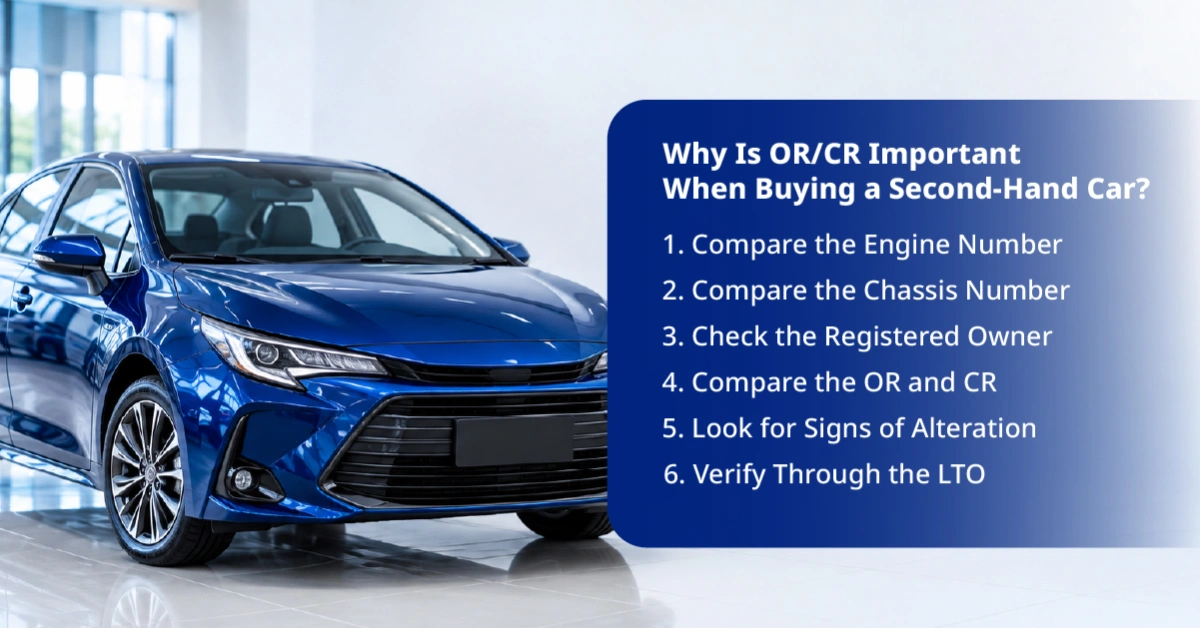
Why Is OR/CR Important When Buying a Second-Hand Car?
Checking the OR/CR is a basic step before you buy a used vehicle.
A document that looks genuine is not enough proof on its own.
Compare the papers with the vehicle itself and, when needed, confirm them through the LTO.
1. Compare the Engine Number
Find the engine number on the vehicle and compare it with the number on the CR.
Even a small difference needs checking before you continue.
2. Compare the Chassis Number
Check the chassis number in the same way.
The number on the vehicle should match the registration records.
3. Check the Registered Owner
Look at the registered-owner information and compare it with the seller’s identification and transaction documents.
If the seller is not the registered owner, ask why and request documents that show the seller’s authority to sell.
4. Compare the OR and CR
The identifying details on both documents should match.
Compare the:
- Plate number
- MV file number
- Vehicle details
- Other identifying information
Clear up any mismatch before you pay.
5. Look for Signs of Alteration
Check the documents for unusual:
- Erasures
- Overwriting
- Altered numbers
- Inconsistent information
- Irregular printing
These signs do not prove fraud, but they are a reason to verify the documents further.
6. Verify Through the LTO
The LTO maintains official motor vehicle registration services through its Land Transportation Management System (LTMS).
If you are unsure about a vehicle’s OR/CR, use the official LTO process instead of relying only on the seller’s documents.
What Happens to the CR When You Buy a Second-Hand Vehicle?
A vehicle sale involves more than signing a deed of sale and transferring possession of the car.
The vehicle’s registration record should also be updated through the LTO’s transfer of ownership process.
Under current LTO rules, the seller generally has reporting obligations following a sale, while the new owner must process the registration and transfer of ownership within 20 working days from the applicable transaction date.
The specific documentary requirements vary depending on the transaction, but LTO requirements for transfer of ownership may include documents such as:
- Original Certificate of Registration
- Current Official Receipt
- Deed of Sale or other applicable proof of transfer
- PNP-HPG clearance
- Motor Vehicle Inspection Report
- Insurance documentation
- Other supporting documents required for the particular transaction
Requirements can change, so buyers and sellers should check the latest LTO guidance before processing the transfer.
Complete the transfer promptly, because LTO records keep showing the old registered owner until they are updated.
What Should You Do If You Have a Lost OR/CR?
A Lost OR/CR can cause delays when you need to sell, transfer, register, or use your vehicle in another transaction.
If a document goes missing, replace it right away instead of waiting until you need it for a transaction.
What to Do If You Lose Your Certificate of Registration
The LTO provides a process for obtaining a Duplicate Certificate of Registration.
The LTO Citizen’s Charter lists Duplicate Certificate of Registration and Duplicate Official Receipt among its motor vehicle registration transactions.
Depending on the circumstances, requirements for a duplicate CR may include:
- Affidavit of Loss
- Applicable law-enforcement clearance
- Motor Vehicle Inspection Report (MVIR)
- Other documents relevant to the vehicle or transaction
Additional documentation may apply when a vehicle has an existing mortgage or encumbrance.
Before visiting an LTO office, check the latest requirements for your particular situation.
What to Do If You Lose Your Official Receipt
If your vehicle’s Official Receipt is lost, you may request a Duplicate Official Receipt through the Land Transportation Office (LTO).
The exact requirements can vary by vehicle record and transaction, so check the latest LTO guidance first.
You can check the official LTO Citizen’s Charter for information on Duplicate Official Receipt transactions, or use the LTO Land Transportation Management System (LTMS) for current vehicle registration services and updates.
Replacing a lost Official Receipt may follow a different process from getting a Duplicate Certificate of Registration, so confirm the requirements for the document you need.
Should You Keep Copies of Your OR and CR?
Keep backup copies of your vehicle documents in case an original is lost or damaged.
Consider keeping:
- Clear photocopies
- Secure digital scans
- Records of relevant transaction details
A photocopy or digital copy does not always replace the original. Some LTO and financing transactions require the original document.
Check the requirements of the particular transaction before relying on a copy.

Why Do Financing Companies Ask for OR/CR?
The OR/CR also matters when a vehicle is used as collateral for a loan.
The financing company uses them to identify the vehicle, review its registration, and confirm the papers meet the product’s requirements.
For vehicle owners who want to use their car as collateral, Asialink Finance Corporation’s Car Refinancing (Sangla OR/CR) is a secured financing option that uses the vehicle’s Official Receipt and Certificate of Registration as part of the collateral requirements.
The exact documentation, eligibility criteria, financing terms, and approval depend on Asialink’s current product requirements and assessment.
Can You Still Use Your Car With Sangla OR/CR?
Yes. With Asialink Finance Corporation’s Sangla OR/CR, you can keep and continue using your vehicle throughout the loan term. The vehicle remains in your possession, while Asialink retains the original Official Receipt and Certificate of Registration (OR/CR) as part of the collateral arrangement.
This applies to Asialink’s Sangla OR/CR. Other lenders may handle collateral and vehicle custody differently.
Before applying, borrowers should understand:
- Document requirements: Which original vehicle documents must be submitted.
- Collateral conditions: How the vehicle serves as security for the financing.
- Repayment obligations: The payment schedule, applicable rates, fees, and loan term.
- Missed-payment consequences: The potential effects of failing to meet repayment obligations.
Although you can continue using your vehicle, it remains collateral for the loan. Failure to meet the agreed repayment obligations may put the vehicle at risk, subject to the financing agreement and applicable laws.
Read the disclosure statement, financing agreement, and terms before you sign.
What OR/CR Requirements Does Asialink Have?
The Official Receipt and Certificate of Registration (OR/CR) are among the main document requirements for Asialink’s Sangla OR/CR product, along with other basic and product-specific requirements.
Asialink’s confirmed Sangla OR/CR requirements for cars, trucks, multicabs, and taxis/public utility vehicles (PUVs) include:
- Official Receipt and Certificate of Registration (OR/CR)
- Latest picture of the vehicle
- Proof of TIN
- Applicable basic loan requirements
- Franchise or Permit to Operate for Taxi/PUV applications, where applicable
Approval, loan amount, rates, fees, terms, and eligibility remain subject to Asialink’s assessment and applicable requirements.
How Can You Protect Your OR and CR?
You will need your vehicle documents at different stages of ownership, so keep them organized to avoid delays.
Consider these practical steps:
- Keep original documents in a secure place.
- Maintain clear backup copies or digital scans.
- Check the information in your documents against the actual vehicle.
- Review the OR and CR carefully before buying a used car.
- Complete the applicable transfer-of-ownership process after buying or selling.
- Take action as soon as possible if your OR/CR is lost.
- Check current LTO requirements before a registration or ownership transaction.
The goal is to keep the details in your OR and CR accurate and consistent with the vehicle and LTO records.
Conclusion
The OR/CR meaning is simple: the OR is the Official Receipt for registration payment, and the CR is the Certificate of Registration that identifies the vehicle and its registered owner.
Keep both accurate and secure, and check them whenever you buy a second-hand car, renew your registration, or replace a lost OR/CR.
For vehicle owners considering car refinancing, Asialink Finance Corporation offers Sangla OR/CR and other vehicle financing solutions, with branches available to assist customers with product information, requirements, and the application process.
*Review Asialink’s current product requirements and financing terms before applying. Approval, loan amount, rates, fees, financing terms, and eligibility are subject to assessment and applicable Asialink requirements.
FAQs
Can I use a photocopy of my OR/CR instead of the original?
Not always. Some LTO and financing transactions require the original document, so a photocopy or digital copy will not be enough. Keep copies as a backup, and check what each transaction requires before you rely on one.
What should I do if I lose my OR or CR?
Replace it through the LTO as soon as possible.
The LTO handles a Duplicate Certificate of Registration and a Duplicate Official Receipt as separate transactions, each with its own requirements. Check the LTO Citizen’s Charter or the LTMS for the latest requirements before you go.
Is the CR proof of vehicle ownership?
The Certificate of Registration identifies the registered owner recorded in the LTO registration system.
The CR shows who is registered with the LTO, but it is not always conclusive legal proof of ownership. Ownership disputes or transactions can involve other legal documents.
What should I check before buying a second-hand car?
Before buying a second-hand OR/CR car, check:
- Engine number
- Chassis number
- Plate number
- MV file number
- Vehicle description
- Registered-owner details
- Consistency between the vehicle and its documents
When necessary, verify the vehicle information through the appropriate LTO process.
What happens if the engine or chassis number does not match the CR?
Stop the transaction until the mismatch has been investigated and verified.
The identifying numbers on the vehicle should be consistent with its registration information. Ask the seller for clarification and consult the LTO regarding the appropriate verification process.