

Key Takeaway
- An SSS Salary Loan is a short-term loan for eligible Social Security System (SSS) members. Potential loan amounts are calculated using their latest posted Monthly Salary Credits (MSCs).
- SSS Salary Loan eligibility depends on contribution history, membership status, existing loan obligations, and current SSS requirements.
- SSS Salary Loans and collateral-backed business financing serve different purposes. The former follows SSS membership and contribution rules, while the latter considers business funding needs, financial qualifications, and eligible collateral.
- Collateral-backed business financing may help eligible business owners access funding for working capital, inventory, equipment, operations, or expansion without necessarily selling eligible assets. Approval remains subject to the lender's assessment.
An SSS salary loan calculator helps eligible members estimate how much they may be able to borrow based on their posted Monthly Salary Credits (MSCs) and applicable SSS rules. However, the amount available depends on their Monthly Salary Credits (MSCs), membership eligibility, and applicable SSS rules.
Understanding SSS loan requirements, repayment terms, and calculation methods helps members make informed borrowing decisions.
For business owners, it is equally important to distinguish member-based lending from financing designed to support business operations and growth.

What Is an SSS Salary Loan?
An SSS Salary Loan is a short-term member loan offered by the Philippine Social Security System to qualified members.
Unlike an employer salary advance, it follows specific SSS membership, contribution, and repayment rules.
Eligibility and loan amounts generally depend on:
- Membership status: Whether the applicant belongs to an eligible SSS membership category.
- Posted contributions: The number of contributions recorded in the member's account.
- Monthly Salary Credits: The compensation bases used to calculate potential loan amounts.
- Existing obligations: Outstanding SSS loans and repayment status.
- Other conditions: Additional requirements under the SSS Salary Loan Program.
The SSS Salary Loan guidelines explain the applicable qualifying conditions, calculation rules, and repayment obligations.
Who Can Apply for an SSS Salary Loan?
Eligible employed, self-employed, voluntary, and land-based Overseas Filipino Worker (OFW) members may apply when they meet the current SSS requirements.
Applicants must satisfy the contribution thresholds, age requirements, membership conditions, and applicable loan-account rules.
Contribution Requirements for a One-Month Salary Loan
A one-month SSS Salary Loan generally requires:
- At least 36 posted monthly contributions
- At least six posted contributions within the 12 months before the application month
Applicants must also meet the remaining eligibility conditions.
Contribution Requirements for a Two-Month Salary Loan
A two-month SSS Salary Loan generally requires:
- At least 72 posted monthly contributions
- At least six posted contributions within the 12 months before the application month
Meeting these contribution thresholds does not automatically guarantee loan approval.
What Are the SSS Loan Requirements?
The main SSS Loan Requirements include:
- Contribution history: Sufficient total and recent posted contributions.
- Membership status: An eligible and correctly recorded membership category.
- Age: Legal age and below 65 years old at application.
- Loan obligations: No disqualifying past-due SSS loans.
- Member records: Updated contact information.
- Disbursement account: An active eligible account enrolled through the Disbursement Account Enrollment Module (DAEM).
- Employer compliance: Applicable contribution and loan-remittance requirements.
Other SSS conditions, including those involving final benefits and previous disqualification, must also be satisfied.
Requirements for Employed Members
Employed applicants generally require electronic employer certification.
The employer must confirm:
- Current employment
- Sufficient net take-home pay for loan amortizations
- Compliance with applicable contribution and loan-remittance requirements
The employer is also responsible for payroll deductions and remitting applicable payments to SSS.
Requirements for Self-Employed, Voluntary, and Eligible OFW Members
Self-employed and voluntary members must meet the applicable contribution and membership requirements.
Under current SSS guidelines, applicants must have at least six posted contributions under their current membership category before applying.
Members should verify their contribution history and membership status through My.SSS, particularly after changing membership categories.
How Is an SSS Salary Loan Calculated?
An SSS Salary Loan is generally calculated using the member's 12 latest posted Monthly Salary Credits (MSCs) under the Regular Social Security Program.
- One-Month Salary Loan: Based on the average of the latest 12 posted MSCs.
- Two-Month Salary Loan: Based on twice the average of the latest 12 posted MSCs.
The estimated loan amount is subject to applicable SSS calculation and rounding rules and cannot exceed the amount requested.
Monthly Salary Credit is not the same as take-home salary. Members should use their posted MSC records rather than their current net income.
What Is a Monthly Salary Credit (MSC)?
Monthly Salary Credit (MSC) is the compensation base used by SSS to calculate contributions and certain benefits and loans.
It follows the applicable SSS contribution guidelines and may differ from a member's actual monthly salary.
For Salary Loan calculations, members should check their posted MSC records through My.SSS.
How to Calculate Your Average Monthly Salary Credit
Follow these steps to estimate your average MSC:
- Check your latest 12 posted MSCs.
- Add the 12 amounts together.
- Divide the total by 12.
- Use the average to estimate your loan amount under the applicable SSS rules.
For example, if your 12 latest MSCs total ₱156,000:
Your average Monthly Salary Credit is ₱13,000.
This figure is a starting point for the calculation, not a confirmed approved loan amount.
SSS Salary Loan Calculator: Step-by-Step Example
Consider a hypothetical member with the following Monthly Salary Credit (MSC) records for the latest 12 posted months:
- Step 1: Find your average MSC.
Add your MSCs for all 12 months, then divide the total by 12.
- Step 2: Estimate your one-month Salary Loan.
A one-month Salary Loan is generally based on one applicable average MSC.
In this example, the estimated loan base is ₱13,000, before applying any relevant SSS rules.
- Step 3: Estimate your two-month Salary Loan.
A two-month Salary Loan is generally based on twice the applicable average MSC.
In this example, the estimated two-month loan base is ₱26,000.
Important: These figures are for educational purposes only and do not represent an official SSS loan quotation. Actual loan amounts depend on SSS calculation rules, eligibility, and the amount requested. The money you receive may also be lower after applicable deductions.
Why the Estimated Loan Amount May Differ From the Amount You Receive
The approved amount and actual net proceeds may differ because of applicable deductions, including:
- Service fees
- Pro-rated interest
- Outstanding balances from previous applicable SSS loans
A calculator based only on MSC information may therefore estimate the loan base without showing the amount ultimately received.
How Does SSS Salary Loan Repayment Work?
Under current SSS guidelines, Salary Loans are generally repaid through 24 equal monthly amortizations.
Repayment begins in the second month following the month of loan approval.
Employed members generally repay through employer payroll deductions. Other eligible member categories make payments through authorized SSS channels.
Interest, Fees, and Monthly Amortization
Beyond the estimated principal, borrowers should understand the interest rate, fees, and total repayment obligation.
Under the SSS Salary Loan guidelines established in Circular No. 2025-004, the applicable terms include:
These figures reflect the published guidelines and may be revised by SSS. The borrower's effective interest rate can also vary based on the loan amount, release date, repayment schedule, and applicable charges.
The monthly amortization represents the scheduled amount the borrower must repay. Borrowers should review the official disclosure statement to understand the full cost rather than relying only on an estimated principal amount.
What Happens if SSS Salary Loan Payments Are Missed?
Missed payments may result in:
- Additional interest and penalties
- Accumulated unpaid amortizations
- Past-due or default status
- Restrictions on loan renewal
- Deductions from applicable future SSS benefits
Under current rules, default may occur when unpaid obligations exceed six monthly amortizations or an unpaid balance remains after the loan term.
Borrowers should review overdue obligations through official SSS channels.
How Accurate Is an SSS Salary Loan Calculator?
An SSS Salary Loan Calculator provides an estimate based on the information entered.
However, it cannot independently confirm:
- Official loan eligibility
- Final approved loan amount
- Applicable deductions
- Actual net proceeds
- Account-specific conditions
A calculator estimate is not an official SSS loan computation or approval.
Members should verify their posted contributions, loan records, and application details through My.SSS.
SSS Salary Loan vs Other Salary Loan Options in the Philippines
When searching for salary loan options in the Philippines, borrowers may encounter several different financing arrangements.
Although some products serve similar funding needs, they operate under different rules.
These financing types are not interchangeable.
An SSS Salary Loan is intended for eligible members' short-term credit needs, while business financing products are structured around specific business purposes and requirements.
Salary Loan vs Collateral Loan: What Is the Difference?
Salary-based or member loans and collateral-backed financing use different assessment approaches.
Collateral-backed business financing allows qualified business owners to use eligible assets, such as vehicles or real estate, as security without necessarily selling them.
Depending on the product, this arrangement may support working capital, inventory, equipment purchases, operational needs, or expansion.
However, secured financing involves repayment obligations and potential risks to pledged assets. It should be assessed according to the business's funding needs and financial capacity.
How Are SSS Salary Loans Different From Asset-Backed Business Financing?
An SSS Salary Loan is a member-based lending program governed by SSS eligibility and contribution rules.
Asset-backed business financing serves a different purpose: providing eligible businesses with funding to support their operations and growth.
Depending on the product, eligible business uses may include:
- Working capital
- Inventory purchases
- Business equipment
- Operational expenses
- Business expansion
These financing structures have separate purposes, requirements, and risks. Asset-backed business financing should not be viewed as a substitute for an SSS Salary Loan.
When You Need a Different Loan Amount
SSS Salary Loan amounts follow the program's MSC calculation rules and applicable eligibility limits.
Business financing amounts are assessed differently. Depending on the product, lenders may consider:
- Business funding requirements
- Operating cash flow
- Repayment capacity
- Credit qualifications
- Eligible collateral value
For businesses planning investments or expansion, the required funding amount should reflect a documented business purpose and realistic repayment capacity.
A larger financing amount is not automatically a better financial decision.
When You Have Eligible Collateral
Some business financing products consider the ownership and value of eligible assets as part of the application assessment.
At Asialink Finance Corporation, eligible collateral categories vary by financing product.
Vehicle categories may include:
- Private cars
- Light and heavy commercial trucks
- Multicabs
- Taxis
- Public Utility Vehicles (PUVs)
Real estate categories may include:
- House-and-lot properties
- Condominium units
- Ready-for-occupancy (RFO) properties
Relevant Asialink products include Car & Truck Refinancing (Sangla OR/CR) and Real Estate Mortgage Loans (Sangla Titulo). Vehicle purchase financing follows different requirements and should not be confused with refinancing an existing asset.
For vehicle-secured financing, the Official Receipt (OR) and Certificate of Registration (CR) should generally indicate ownership under the applicant's name.
Applicants with eligible second-hand vehicles may still be considered when ownership transfer is incomplete, provided they submit a notarized Deed of Sale and complete the required ownership transfer upon loan release.
For real estate mortgage financing, the Original Certificate of Title (OCT), Transfer Certificate of Title (TCT), or Condominium Certificate of Title (CCT) may be relevant, depending on the property. The title should ideally be registered in the borrower's name.
Applicants should prepare a completed application form, valid government-issued IDs, proof of income, proof of residency, and other applicable documents. Additional loan requirements may include vehicle registration records, property documents, or business registration and operating records.
Collateral acceptance depends on ownership verification, valuation, documentation, credit assessment, and product eligibility. Possessing an eligible asset does not guarantee financing.
Understand the Additional Risk of Secured Financing
Secured financing uses an eligible asset as security for repayment.
Before applying, business borrowers should understand:
- Collateral and ownership requirements
- Repayment schedule and loan term
- Interest, fees, and total borrowing costs
- Consequences of missed payments
- Potential enforcement against collateral
If a borrower defaults, the lender may enforce its rights over the collateral under the financing agreement and applicable laws.
Collateral is not automatically or immediately repossessed after a single missed payment, but borrowers should understand the potential consequences before signing.
What Asialink Financing Options Can Borrowers Explore?
Asialink Finance Corporation provides financing solutions designed to help eligible businesses address operational requirements and support growth.
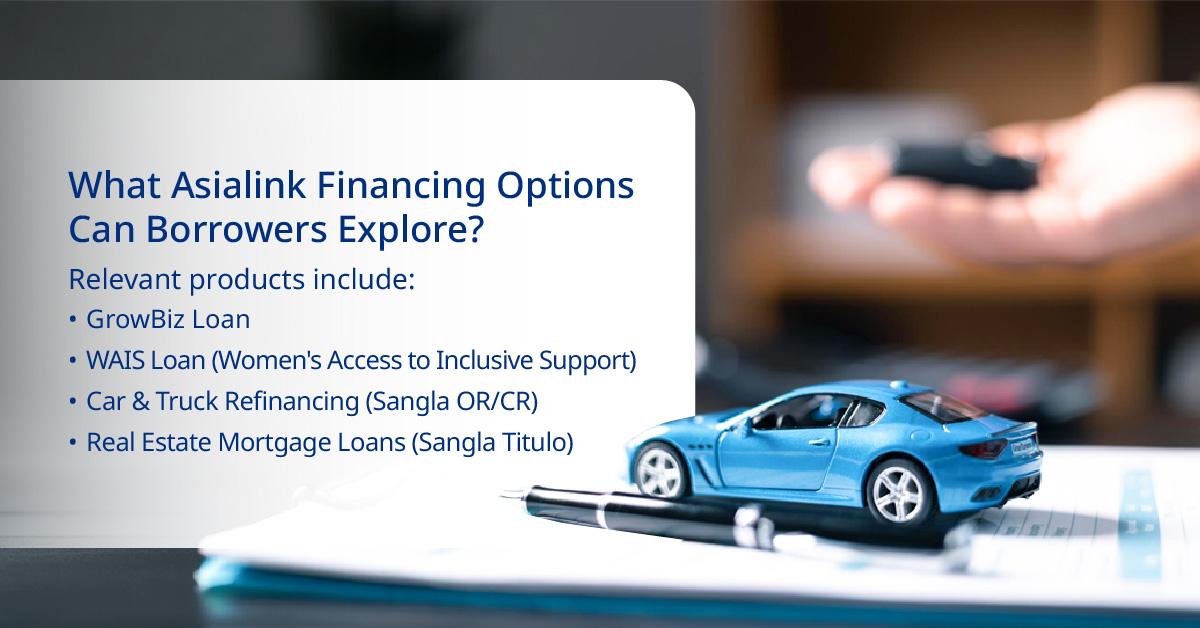
Relevant products include:
- GrowBiz Loan: Business financing that may support eligible working capital requirements, operating needs, and expansion, secured by qualifying assets under the product's terms.
- WAIS Loan (Women's Access to Inclusive Support): Financing designed for eligible women-led micro, small, and medium enterprises (MSMEs).
- Car & Truck Refinancing (Sangla OR/CR): Vehicle-secured financing that may support eligible business funding purposes, subject to the applicable terms.
- Real Estate Mortgage Loans (Sangla Titulo): Property-secured financing that may be considered for qualifying business-related funding needs.
Each product has separate documentation, collateral, eligibility, and approval requirements.
Asialink aims to support qualified businesses in evaluating financing arrangements that align with their working capital, inventory, equipment, operational, or expansion needs, where permitted by the applicable product terms.
Business owners can explore our financing products to understand the available options.
What Should You Compare Before Choosing a Loan?
Before entering any financing agreement, review the following factors:
- Financing purpose: Confirm that the product supports the intended use.
- Eligibility: Check the applicable borrower and documentation requirements.
- Amount required: Identify the actual funding need.
- Interest and fees: Understand how financing costs are calculated.
- Repayment capacity: Assess available income or business cash flow.
- Repayment term: Review the payment schedule and total repayment amount.
- Collateral requirements: Understand ownership conditions and asset-related risks.
- Default consequences: Review penalties and potential enforcement measures.
For business financing, it is particularly important to determine whether the expected business cash flow can reasonably support repayment.
Financing should support a defined purpose without placing unnecessary pressure on financial stability or business operations.
Conclusion
An SSS salary loan calculator helps eligible members estimate their potential loan amount using their latest posted Monthly Salary Credits. Actual eligibility and loan proceeds depend on contribution history, membership status, existing obligations, and current SSS requirements.
Before applying, members should review their contribution records, repayment terms, applicable fees, and ability to repay.
For eligible businesses seeking funding for working capital, inventory, equipment, operations, or expansion, Asialink Finance Corporation offers business-focused financing solutions, including GrowBiz Loan, WAIS Loan, and qualifying asset-backed financing products.
These solutions are designed for financing purposes different from those of SSS Salary Loans. Availability, permitted uses, collateral requirements, and approval conditions depend on the specific product.
FAQs
Does Checking an SSS Salary Loan Estimate Affect My SSS Account?
Calculating an estimate using your MSC information does not constitute a loan application or change your contribution history. However, an external calculator cannot confirm official eligibility. Use My.SSS to verify your records and actual application details.
Can I Apply for an SSS Salary Loan if I Recently Changed Employers?
You may still be eligible if you meet the current SSS requirements. Your posted contributions, employment records, employer certification, and applicable remittance conditions must be properly addressed. Check My.SSS and coordinate with your current employer.
Does a Higher Salary Automatically Mean a Higher SSS Salary Loan?
No. The potential loan amount depends on your latest posted MSCs and applicable SSS calculation rules, not simply your current salary. Contribution history, eligibility, requested amounts, and existing obligations may also affect the result.
Can I Have an SSS Salary Loan and Another Loan at the Same Time?
Having another loan does not automatically disqualify you from every financing program. However, SSS applies specific rules to existing member loans and past-due accounts. Other lenders may also assess outstanding obligations and repayment capacity.
Can I Use an SSS Salary Loan Calculator Without Applying for a Loan?
Yes. You can estimate a potential loan amount without submitting an application. However, the result is illustrative. Official eligibility, applicable deductions, and final loan proceeds must be confirmed through SSS.