

Key Takeaway
- LTO registration renewal follows a schedule based on the vehicle's plate number. The last digit determines the renewal month, while the preceding digit determines the registration week.
- Car registration renewal requirements generally include registration documents, valid insurance, vehicle inspection records, and emission compliance documents where applicable.
- LTO renewal fees vary depending on vehicle classification, weight, inspection requirements, and additional charges or late penalties.
- Expired vehicle registration should be addressed promptly. Vehicle owners should complete the required renewal process before driving or proceeding with transactions that require valid registration.
Renewing your car registration is a regular responsibility for vehicle owners in the Philippines. Understanding how to renew your car registration with the LTO can help you prepare the necessary documents, complete required inspections, and renew your registration on time.
The process involves checking your registration date, preparing your OR/CR and insurance, meeting inspection and emission requirements, and paying the applicable fees.
For buyers of second-hand vehicles, understanding LTO registration renewal is equally important. Updated registration records help verify vehicle details and identify documentation issues before purchasing or applying for financing.
When Do You Need to Renew Your Car Registration With LTO?
The Land Transportation Office (LTO) uses a staggered registration schedule based on the vehicle's plate number.
The last digit determines the registration month, as shown below.
For example, if your plate number ends in 6, your scheduled registration month is June.
The digit immediately before the last digit determines the applicable registration week.
Vehicle owners should also consider their current registration validity. Newly registered vehicles and vehicles covered by extended initial registration periods may follow different validity arrangements before their regular renewal schedule applies.
How to Determine Your Registration Week
Under the LTO's staggered schedule, the second-to-last plate digit determines the registration week.
For example, a vehicle with a plate number ending in 56 is scheduled for renewal in June, during the second week.
The schedule generally uses working days within the applicable period. Vehicle owners should check the latest LTO registration schedule before renewing, as regulations and administrative arrangements may change.
What Are the Car Registration Renewal Requirements?
The car registration renewal requirements depend on the vehicle's classification and the applicable renewal process.
Under the LTO's registration procedures, commonly required documents include:
- Latest Official Receipt and Certificate of Registration (OR/CR): Registration records used to identify the vehicle and verify its details.
- Valid Insurance Certificate of Cover (COC): Proof of the required motor vehicle insurance coverage.
- Vehicle Inspection Report: An applicable Motor Vehicle Inspection System Report (MVISR) or Motor Vehicle Inspection Report (MVIR).
- Certificate of Emission Compliance (CEC): Required where applicable under the vehicle's inspection and emission compliance arrangements.
- Additional documents: Supporting records for special transactions or vehicle classifications.
Requirements may differ for private cars, for-hire vehicles, government vehicles, and other classifications.
The LTO motor vehicle registration requirements distinguish between standard renewal documents and the applicable electronic or physical inspection and insurance records.
Latest OR and CR
The vehicle's latest registration documents may be needed during renewal, depending on the transaction channel.
- Official Receipt (OR): Records the applicable vehicle registration payment.
- Certificate of Registration (CR): Contains registered information about the vehicle, including its identification details and registered owner.
For some eligible online renewal transactions, existing vehicle records may already be available electronically.
Owners should still keep their OR/CR records accessible and check that the information is accurate.
Insurance Certificate of Cover
Valid motor vehicle insurance documentation is an important requirement for registration renewal.
The Insurance Certificate of Cover (COC) confirms the applicable insurance coverage. For standard private vehicle registration, Compulsory Third Party Liability (CTPL) insurance is generally required.
Depending on the insurer and registration process, insurance information may be electronically authenticated and transmitted to the relevant LTO system.
Vehicle owners should confirm that their coverage is valid and properly recorded before completing the transaction.
Vehicle Inspection Requirements
Vehicle inspection helps establish whether a vehicle meets the applicable roadworthiness requirements.
Depending on the vehicle classification and renewal route, inspection documentation may include:
- Motor Vehicle Inspection System Report (MVISR)
- Motor Vehicle Inspection Report (MVIR)
- Inspection results from an authorized inspection facility
An authorized vehicle inspection may include checks of safety-related components and the vehicle's overall roadworthiness.
Not every vehicle follows exactly the same inspection procedure. Owners should confirm the appropriate inspection route before visiting a facility.
Emission Compliance
Emission testing helps verify compliance with applicable environmental requirements.
Vehicles requiring separate emission testing may need a valid Certificate of Emission Compliance before registration renewal.
The Philippine Clean Air Act of 1999 establishes the broader framework for controlling motor vehicle emissions.
However, the actual testing requirement depends on the vehicle type, applicable inspection process, and current LTO procedures.
Certain vehicles, including fully electric vehicles, may have different emission-testing requirements.
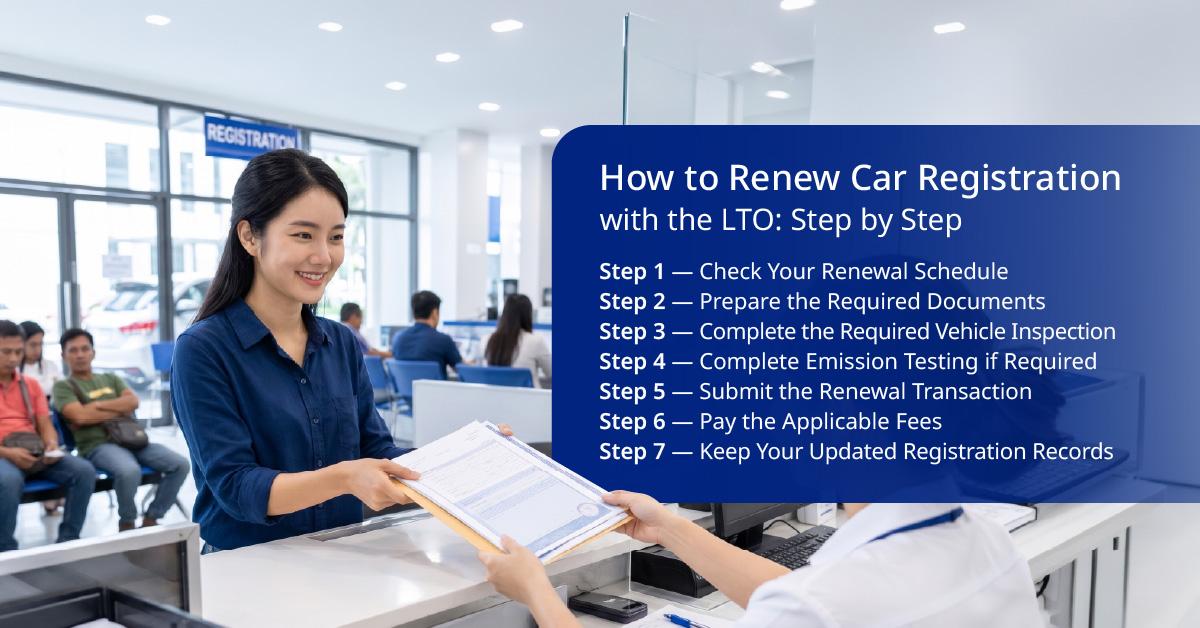
How to Renew Car Registration with the LTO: Step by Step
If you want to know how to renew your car registration with the LTO, the following seven steps outline the general process.
Step 1 — Check Your Renewal Schedule
Start by checking your vehicle's plate number.
- Identify the last digit to determine the renewal month.
- Check the Second-to-Last Plate Digit to identify the scheduled registration week.
- Review your existing registration records to confirm validity.
- Plan to complete the renewal before the applicable deadline.
The plate-number schedule provides a useful guide, but owners should confirm any special validity arrangements or updated LTO instructions.
Step 2 — Prepare the Required Documents
Before starting the renewal transaction, prepare the applicable documents:
- Latest OR/CR records
- Valid Insurance Certificate of Cover
- Required vehicle inspection documents
- Emission compliance documents, where applicable
- Additional documents for special vehicle classifications or transactions
Check that the registration details, insurance information, and vehicle identifiers are consistent.
Step 3 — Complete the Required Vehicle Inspection
Arrange the required vehicle inspection through an authorized LTO inspection channel or facility.
The inspection process may vary depending on the vehicle and the available registration route.
If the vehicle does not pass the applicable inspection, the owner may need to address the identified issues and complete reinspection before proceeding.
Step 4 — Complete Emission Testing if Required
If separate emission testing applies, visit an authorized testing facility and obtain the required compliance result.
Some authorized inspection arrangements may incorporate emission testing into the overall vehicle inspection process.
Confirm the applicable procedure beforehand to avoid unnecessary duplicate testing.
Step 5 — Submit the Renewal Transaction
Once you have completed the requirements, submit your registration renewal application through the appropriate LTO channel.
Some eligible renewals may be supported through the LTO Land Transportation Management System (LTMS), which provides digital access to selected LTO services.
However, not all vehicle registration renewals can necessarily be completed fully online.
Eligibility depends on the vehicle's records, inspection results, transaction type, and current system availability.
Where an in-person transaction is required, submit the necessary documents through an authorized LTO office.
Step 6 — Pay the Applicable Fees
After the renewal information is processed, pay the assessed registration charges through the authorized payment channel.
The total may include:
- Registration-related charges
- Motor Vehicle User's Charge (MVUC)
- Vehicle inspection and emission testing fees
- Applicable miscellaneous charges
- Late renewal penalties, where relevant
Review the official assessment before making payment.
Step 7 — Keep Your Updated Registration Records
After completing the renewal, retain the updated payment and registration records.
Check that the details are correct and keep the documents accessible for future transactions.
Updated OR/CR records can be important when selling a vehicle, transferring ownership, or applying for eligible vehicle financing.
How Much Are LTO Renewal Fees?
LTO renewal fees do not have one fixed total for every vehicle.
The amount depends on several factors, including:
- Vehicle type and classification
- Gross vehicle weight
- Applicable Motor Vehicle User's Charge
- Inspection requirements
- Emission testing
- Miscellaneous registration transactions
- Late renewal penalties
- Other applicable charges
A private passenger car and a commercial truck, for example, may have different registration-related charges.
The LTO motor vehicle registration fee schedule lists separate fees for vehicle inspections and other registration transactions.
Owners should verify the latest applicable charges and request the official assessment rather than relying on a single estimated renewal price.
Vehicle Inspection and Emission Fees
Inspection-related costs vary according to the vehicle's classification, gross vehicle weight, and applicable testing requirements.
For example, private vehicles and heavier commercial vehicles may fall under different inspection fee categories.
Separate emission testing or reinspection charges may also apply when required.
The total cost should therefore include both the applicable registration charges and any necessary testing expenses.
Other Possible LTO Charges
Some vehicle owners may need to complete additional transactions alongside or separately from registration renewal.
These may involve:
- Duplicate OR or CR documents
- Transfer of vehicle ownership
- Mortgage annotation or cancellation
- Updates to vehicle identification or registration details
- Late registration or other applicable penalties
These charges are not necessarily part of a standard annual renewal.
They apply when the specific transaction is required.
What Happens if Your Car Registration Expires?
Allowing vehicle registration to expire can create legal, administrative, and financial complications.
Possible consequences include:
- Additional registration charges or late penalties
- Violations associated with operating a vehicle without valid registration
- Delays in ownership transfer or other vehicle transactions
- Additional document verification
- Concerns from prospective second-hand vehicle buyers
Under the LTO's published motor vehicle registration enforcement rules, operating a vehicle with expired or invalid registration can lead to enforcement action and applicable penalties.
Vehicle owners should not continue driving a vehicle with expired registration on public roads until its registration status has been properly addressed.
Can You Still Renew an Expired Registration?
In general, an expired registration does not permanently prevent a vehicle from being registered again.
However, the owner may need to:
- Complete the applicable renewal requirements.
- Obtain valid insurance documentation.
- Complete the necessary inspection and emission procedures.
- Pay outstanding registration charges and applicable penalties.
- Resolve any additional documentation or compliance issues.
The actual process depends on the vehicle's registration history and current LTO requirements.
What if the Registration Has Been Expired for Several Years?
A vehicle whose registration expired several years ago may require additional review.
Possible requirements include updated inspections, registration record verification, supporting documents, and settlement of applicable charges.
Long-expired registrations should be assessed individually rather than using a single assumed penalty calculation.
For unusual cases, contact an authorized LTO office to confirm the applicable procedure before arranging the renewal.
What Is OR/CR Renewal?
OR/CR renewal is a common term used by vehicle owners when referring to the renewal of their vehicle registration.
However, OR/CR renewal generally refers to renewing the vehicle's registration, not renewing the Official Receipt (OR) and Certificate of Registration (CR) separately.
The documents serve different purposes:
- OR: Records the applicable registration payment.
- CR: Identifies the registered vehicle and its registration details.
During renewal, the owner completes the required registration transaction and receives or accesses the appropriate updated records.
If an OR or CR has been lost, obtaining a replacement document may involve a separate procedure.

What Should You Check Before Renewing the Registration of a Used Car?
Buyers of second-hand vehicles should review the registration status before completing the purchase.
Important checks include:
- Registered owner's name
- Plate number
- Engine number
- Chassis number
- Vehicle make and model
- Registration validity
- Mortgage or financing notation, where applicable
- Missing or inconsistent ownership documents
An expired registration does not automatically mean the vehicle is defective.
However, buyers should understand why the registration expired, whether penalties remain unpaid, and who will be responsible for renewal.
The parties should also confirm that the required ownership documents are available and accurate.
Confirm the Vehicle Details Match the OR/CR
Compare the physical vehicle with the information recorded in its OR/CR.
Check the following:
- Vehicle make
- Model and year
- Engine number
- Chassis number
- Plate number and identifying details
Discrepancies may require clarification or correction before registration renewal or ownership transfer.
Buyers should not rely solely on the seller's statements when important vehicle identifiers do not match.
Check the Registered Owner Before Buying
Check that the registered owner's details are consistent with the seller's identification and supporting documents.
If the seller is not the registered owner, additional documentation may be needed to establish the seller's authority to complete the transaction.
A notarized Deed of Sale may form part of the supporting ownership documentation.
Before purchasing, buyers should confirm the applicable ownership transfer requirements with the LTO, particularly when the vehicle has changed hands without an updated Certificate of Registration.
Can an Expired Registration Affect Car Financing?
Vehicle financing providers may review registration status as part of their documentation and collateral assessment.
Common considerations include:
- Vehicle OR/CR records
- Registered ownership
- Registration validity
- Vehicle condition and valuation
- Supporting borrower documents
An expired registration does not necessarily mean a financing application will be rejected.
At Asialink Finance Corporation, applicants may submit eligible vehicles with expired registration for initial assessment and appraisal.
Applicants do not need to renew their vehicle registration before the initial appraisal. The application may proceed through assessment while the registration issue is being resolved. However, registration must be renewed before loan proceeds can be released, subject to Asialink's applicable requirements.
However, the vehicle's registration must be renewed before loan proceeds can be released or claimed.
This distinction applies generally to our Car & Truck Refinancing (Sangla OR/CR) and eligible Second-Hand Car Financing arrangements.
Both products require appropriate OR/CR documentation, but their additional eligibility and documentation requirements differ.
For Sangla OR/CR involving taxis or Public Utility Vehicles (PUVs), a franchise or permit to operate may also be required.
All applications remain subject to assessment, documentation requirements, and approval.
What Asialink Financing Options Can Car Owners Explore?
Asialink Finance Corporation provides vehicle financing solutions for qualified owners and buyers.
Our relevant products include:
- Car & Truck Refinancing (Sangla OR/CR): Financing secured by eligible vehicles, subject to ownership, collateral valuation, and credit assessment.
- Auto & Truck Financing: Financing for eligible brand-new and second-hand vehicle purchases, subject to product-specific requirements.
These products have different purposes, eligibility criteria, and documentation requirements.
Vehicle owners and buyers can explore our financing products to understand the available financing options and applicable terms.
Those who prefer to discuss their financing needs in person can also locate an Asialink branch through our nationwide branch directory.
Registration renewal itself remains an LTO transaction, separate from Asialink's financing services. Loan approval is subject to the applicable assessment and documentation process.
Tips to Avoid Missing Your LTO Registration Renewal
A few simple steps can help vehicle owners prepare for renewal and avoid unnecessary delays.
- Know your registration schedule. Check the final two digits of your plate number to identify the scheduled month and week.
- Set an early reminder. Plan the renewal ahead of your deadline.
- Review your OR/CR. Check vehicle identification and ownership details before starting.
- Prepare insurance documents. Confirm valid coverage and electronic records where applicable.
- Arrange inspections early. Check the authorized inspection and emission requirements for your vehicle.
- Verify updated procedures. Review the latest instructions from the LTO before submitting your renewal.
- Avoid last-minute transactions. Allow sufficient time to address missing records, inspection findings, or additional requirements.
Early preparation can make the process more manageable, particularly when the vehicle requires extra documentation.
Conclusion
Understanding how to renew your car registration with the LTO starts with knowing your plate-number schedule and preparing the required documents.
Vehicle owners should check their OR/CR, arrange valid insurance, complete the applicable inspection and emission requirements, and review the assessed renewal fees.
If registration has expired, addressing the issue promptly can help prevent further complications. Keeping updated records is also important for second-hand vehicle purchases, ownership transfers, and financing applications.
At Asialink Finance Corporation, we understand the importance of complete and accurate vehicle documentation when evaluating financing applications. Our vehicle financing solutions are available to eligible applicants, subject to ownership verification, collateral assessment, documentation requirements, and approval.
FAQs
Can I Renew My Car Registration Before My Scheduled Month?
Early renewal may be allowed under applicable LTO rules. LTO registration guidance has provided for renewal up to two months in advance, subject to the relevant requirements. Check your existing registration validity and confirm the current early-renewal procedure with the LTO before proceeding.
Can Someone Else Renew My Car Registration for Me?
An authorized representative may be able to handle an LTO registration renewal on behalf of the vehicle owner. Additional identification and authorization documents may be required. Confirm the requirements with the LTO office handling the transaction before sending a representative.
Do I Need the Original OR/CR for LTO Registration Renewal?
Not every renewal transaction requires physical original OR/CR documents. Requirements depend on the registration channel and the vehicle's existing records. Some eligible online transactions use electronically available information, while certain in-person or special transactions may require supporting copies or documents.
Can I Renew My Registration if I Lost My OR or CR?
Losing an OR or CR does not necessarily prevent registration renewal, but you may need to obtain a replacement or complete document verification first. The LTO has separate procedures for duplicate registration documents. Confirm which records are required before proceeding.
Can a Car With an Existing Loan Be Registered With LTO?
A vehicle with an existing financing or mortgage arrangement may still undergo registration renewal, subject to applicable LTO requirements. The vehicle's ownership details and mortgage or financing notation should remain accurate. Any change affecting the registered financing arrangement may require additional documentation or coordination with the lender.