
Cars with Loan in the Philippines: A Buyer’s Guide
Key Takeaway
- Buying a vehicle with an outstanding loan requires checking its financing balance, registration documents, and ownership records.
- An assumption-of-balance arrangement does not automatically transfer the seller’s loan obligations to the buyer.
- Buyers should verify the OR/CR, registered owner, vehicle identifiers, and any recorded loan or lien on the car before paying.
- Available financing options depend on the existing lender, vehicle eligibility, buyer qualifications, and applicable approval requirements.
Buying a car with an outstanding loan in the Philippines requires more than checking the vehicle’s price and condition. If the seller still has an outstanding auto loan, the vehicle may still have an unpaid loan that affects how the sale and ownership transfer can proceed.
Before making a payment, buyers should understand the remaining financing obligation, verify the Official Receipt and Certificate of Registration (OR/CR), and determine whether the existing lender must participate in the transaction.
This guide explains assumption of balance, vehicle document checks, ownership transfer, and financing considerations to help buyers make informed decisions.
Can You Buy a Car That Still Has an Outstanding Loan?
A vehicle can be offered for sale even when its financing obligation remains unpaid. However, the transaction may require additional steps before the buyer can complete the ownership transfer.
A financed vehicle may be covered by a chattel mortgage, which gives a financing provider a security interest in the vehicle. This arrangement may appear in the registration records as an existing loan or lien.
The Land Transportation Office (LTO) recognizes registration procedures involving mortgage annotations and Certificates of Registration–Encumbered (CRE).
An outstanding loan does not automatically make a vehicle impossible to purchase. However, buyers must understand how the financing obligation will be handled and what documents are required to clear the existing loan or lien.
Why an Outstanding Auto Loan Matters
An unpaid auto loan may affect the transaction because the financing provider can retain contractual rights connected to the vehicle.
Important considerations include:
- Outstanding balance: The remaining amount owed under the financing agreement.
- Chattel mortgage: The security arrangement connected to the vehicle.
- Recorded loan or lien: A recorded claim or restriction that may affect registration transactions.
- Original documents: Certain documents may remain with the financing provider.
- Contractual restrictions: The loan agreement may require approval before a sale or transfer.
Possessing the vehicle does not necessarily mean the seller can transfer clear ownership immediately.
Buyers should verify these matters before agreeing to the purchase.
Should You Pay the Seller Before the Loan Is Settled?
Paying a substantial amount before understanding the existing loan can create financial and documentation risks.
Before payment, confirm:
- The current outstanding balance.
- The identity of the financing provider.
- The applicable loan settlement procedure.
- The documents required to release the existing loan or lien.
- How and when the vehicle documents will become available.
Ask for current financing information and independently verify relevant details through an authorized channel where possible.
The buyer and seller should also document their agreed responsibilities.
Buyers should understand how the outstanding financing will be settled and documented before completing payment.
Payment arrangements depend on the lender’s procedures. Do not assume that paying the seller automatically settles the loan.
What Is Assumption of Balance?
Assumption of balance is a term commonly used in the Philippines for an arrangement in which another person agrees to continue paying the remaining balance on a financed vehicle.
For example, a seller may offer a car in exchange for an initial payment, while the buyer agrees to handle the remaining installments.
However, a private agreement between the buyer and seller does not necessarily transfer the existing loan contract.
The financing provider may still recognize the original borrower as responsible for repayment.
How Does Assumption of Balance Work?
A typical arrangement may involve these steps:
- The seller has a vehicle with an outstanding loan.
- The buyer expresses interest in acquiring the vehicle.
- Both parties discuss the initial payment and remaining financing obligation.
- The existing lender determines whether a formal transfer or alternative arrangement is permitted.
- The parties complete the applicable documentation and registration procedures.
The key distinction is between two arrangements:
- Informal private arrangement: The buyer agrees with the seller to continue making payments without necessarily changing the original financing contract.
- Lender-approved arrangement: The financing provider formally reviews and approves the applicable change or new financing structure.
These arrangements should not be treated as equivalent.
Is Assumption of Balance the Same as Transferring the Auto Loan?
Not necessarily.
Under an informal assumption-of-balance arrangement, the buyer may make payments while the original loan remains under the seller’s name.
A formal loan transfer, where permitted, involves the financing provider’s consent and the required contractual documentation.
Under Article 1293 of the Civil Code of the Philippines, substituting a new debtor for the original borrower requires the creditor’s consent. Therefore, a private payment arrangement does not automatically transfer the original financing obligation to the buyer.
Before proceeding, buyers should confirm:
- Who remains responsible under the financing agreement.
- Whether the lender recognizes the proposed arrangement.
- What happens if payments are missed?
- When the vehicle can be transferred into the buyer’s name.
The enforceability of a particular arrangement depends on its terms and applicable law. Buyers should seek qualified legal advice when the agreement or its consequences are unclear.
What Should You Check Before Buying Cars with Loan?
Before buying a car with an outstanding loan, complete basic checks covering the seller, vehicle, financing obligation, and supporting documents.
A useful due-diligence checklist includes:
- Seller identity and authority to sell
- Registered-owner information
- Original OR/CR and registration status
- Engine and chassis numbers
- Existing loan or lien
- Remaining loan balance
- Current financing provider
- Settlement and document-release procedure
- Vehicle condition and maintenance history
These checks help identify issues that may delay or prevent a proper transfer.
Verify the Seller and Registered Owner
Start by comparing the seller’s identification with the registered-owner information on the Certificate of Registration.
If the names differ, ask why and request documents establishing the seller’s authority to transact on the owner’s behalf.
Depending on the circumstances, supporting documents may include a properly executed authorization or other ownership-related records.
Possession of the vehicle, keys, or photocopied documents does not prove ownership.
Unexplained discrepancies should be resolved before payment.
Confirm the Outstanding Loan Balance
Ask whether the vehicle still has an unpaid financing obligation.
If it does, confirm:
- The current balance, including applicable settlement charges.
- The financing provider responsible for the account.
- Whether an early settlement is permitted.
- The process for obtaining release documents.
- How the existing loan or lien on the vehicle will be cleared.
An old payment schedule or verbal statement may not reflect the current settlement amount.
Where possible, request updated documentation and verify the settlement procedure with the financing provider.
What Should You Check on the OR/CR Before Paying?
The Official Receipt (OR) and Certificate of Registration (CR) are important documents for checking a vehicle’s registration details.
Before completing the purchase, compare the documents with the vehicle and seller information.
Review:
- Registered owner
- Plate or registration information
- Engine number
- Chassis number
- Vehicle make and model
- Registration status
- Recorded loan or lien, where applicable
Any discrepancy should be investigated before proceeding.
Check the Registered Owner
The CR identifies the vehicle’s registered owner.
Compare the name with the seller’s identification and the proposed sale documents.
If the seller is not the registered owner, determine what documentation establishes their authority to complete the transaction.
A signed agreement alone should not replace verification of the registration record.
Match the Vehicle Identifiers
Compare the registration details with the physical vehicle.
Check the:
- Engine number
- Chassis number
- Plate number or registration identifiers
- Make
- Model
Numbers should match the corresponding records.
Signs of alteration or inconsistent information require further verification through appropriate authorities.
A visual inspection can identify discrepancies, but it does not independently establish clear ownership or an absence of financing obligations.
Check Whether the Vehicle Has an Existing Loan or Lien
An existing loan or lien is a recorded claim or security interest connected to a vehicle.
For a financed car, this may arise from a chattel mortgage securing the outstanding obligation.
A registration with an existing loan or lien does not automatically mean the car cannot be sold. However, the parties may need to settle the financing and complete cancellation or release procedures before the ownership records can be properly updated.
Buyers should confirm the status through appropriate documentation rather than relying only on the seller’s explanation.
What Happens to the OR/CR When the Existing Auto Loan Is Paid Off?
Settling a vehicle loan is an important step, but repayment and removal of the recorded loan or lien from the registration are separate matters.
The process may involve:
- Loan settlement: The outstanding obligation is paid according to the financing agreement.
- Release documentation: The financing provider issues the applicable documents confirming the release of the security interest.
- Cancellation of the recorded loan or lien: The required cancellation or release is processed through the relevant authorities.
- Registration update: Vehicle registration records are updated as applicable.
- Ownership transfer: The buyer completes the required transfer procedure.
According to the Land Transportation Office’s cancellation of mortgage requirements, the process generally involves the Certificate of Registration–Encumbered (CRE) and the applicable cancellation or release of chattel mortgage documentation.
Buyers should confirm which original documents will be released, who will handle each step, and whether additional documentation or charges apply.
The process should not be considered complete merely because the remaining loan installments have been paid. Registration records must also be updated through the applicable procedures.
How Does Transfer of Ownership Work After Buying the Vehicle?
In the Philippines, vehicle ownership transfers must be reported and recorded through the applicable Land Transportation Office (LTO) procedures.
Depending on the transaction, requirements may include:
- A properly executed deed of sale or transfer
- Valid identification documents
- Vehicle registration records
- Applicable inspection and clearance documents
- Additional documentation for vehicles with an existing loan or lien
The LTO’s guidelines on the transfer of motor vehicle ownership address the reporting and recording of vehicle ownership transfers and the importance of maintaining accurate registration records.
Buyers should verify the current documentation requirements and applicable deadlines directly with the LTO, as procedures may be updated.
An open deed of sale should not be treated as a permanent substitute for properly recording the transfer of ownership.
Completing the required registration process helps establish a clearer ownership record and may reduce complications involving future registration, resale, financing, or insurance transactions.
Why the Transfer Should Be Properly Recorded
Accurate ownership records matter for several reasons:
- Legal records: The registration identifies the recorded vehicle owner.
- Transaction clarity: Proper documentation reduces uncertainty about the transfer.
- Future registration: Renewal and other vehicle transactions may require accurate records.
- Resale and financing: Subsequent buyers or financing providers may review ownership history.
- Insurance: Accurate registration information can help avoid documentation complications.
Completing the required transfer procedures helps establish a clearer record of the transaction.
What Are Your Financing Options if the Seller Still Owes Money?
Several arrangements may be considered when purchasing a financed vehicle. Their availability depends on the existing financing agreement, lender policies, and buyer qualifications.
Possible options include:
- The seller settles the loan before completing the sale.
- The parties arrange for part of the purchase proceeds to settle the outstanding obligation.
- The buyer applies for separate financing to purchase the vehicle.
- The existing lender considers an approved transfer or restructuring arrangement, if available.
No single approach is suitable or available in every transaction.
Buyers should understand the documentation, settlement responsibilities, and ownership-transfer requirements before proceeding.
Seller Pays Off the Existing Auto Loan
One possible arrangement is for the seller to settle the outstanding auto loan before transferring the vehicle.
The general sequence is:
- The seller obtains the current settlement amount.
- The remaining financing obligation is paid.
- The required release documents are obtained.
- The recorded loan or lien is cleared through the applicable procedure.
- The parties proceed with the sale and ownership transfer.
This arrangement separates the existing financing obligation from the buyer’s purchase, provided the required release and registration steps are completed.
Processing time depends on the financing provider and relevant authorities.
Buyer Applies for Financing for the Vehicle
A buyer may apply for a separate auto loan to purchase an eligible second-hand vehicle.
The financing provider will assess both the applicant and vehicle. Approval may depend on income, repayment capacity, vehicle age, condition, documentation, and other requirements.
The existing obligation must still be handled through an acceptable settlement and transfer arrangement.
Buyers should confirm whether the financing provider can accommodate the proposed transaction before committing to the purchase.
What Are the Requirements for a Second-Hand Auto Loan?
Requirements for a second-hand auto loan vary by financing provider and the type of vehicle being purchased.
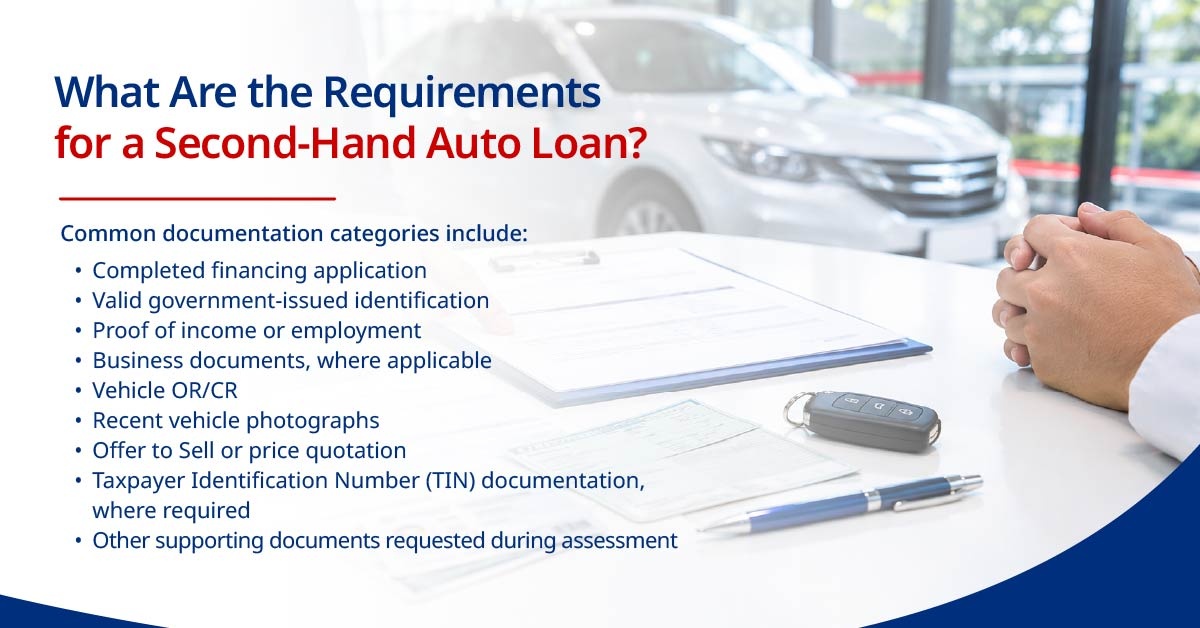
Common documentation categories include:
- Completed financing application
- Valid government-issued identification
- Proof of income or employment
- Business documents, where applicable
- Vehicle OR/CR
- Recent vehicle photographs
- Offer to Sell or price quotation
- Taxpayer Identification Number (TIN) documentation, where required
- Other supporting documents requested during assessment
The financing provider may also inspect or appraise the vehicle.
For a vehicle with an outstanding loan, additional settlement and release documentation to clear the existing loan or lien may be necessary.
Preparing the required documents can help applicants understand the transaction requirements, but complete submission does not guarantee financing approval.
How to Compare Auto Loan Options in the Philippines
When evaluating auto loan options in the Philippines, compare the overall financing arrangement rather than focusing only on the advertised rate or monthly installment.
Important factors include:
| Factor | What to Compare |
|---|---|
| Amount financed | Actual principal and required down payment |
| Interest rate | Rate period and calculation method |
| Fees | Processing, documentation, and other charges |
| Loan term | Available repayment periods |
| Monthly payment | Scheduled amount and included costs |
| Total repayment | Estimated amount payable over the full term |
| Vehicle eligibility | Age, condition, and documentation requirements |
| Collateral conditions | Security interest and release requirements |
| Early settlement | Applicable conditions and charges |
| Late payment | Penalties and consequences of missed payments |
Ask for written financing details to understand the applicable obligations.
Look Beyond the Monthly Payment
A lower monthly payment does not automatically mean a lower-cost auto loan.
The difference may result from:
- A longer repayment period
- A different interest rate
- A larger down payment
- A smaller financed amount
- A different calculation method
For example, two financing offers may have similar monthly payments but substantially different total repayment amounts.
Compare the full cost before deciding.
Compare Loan Term and Total Cost
Under the same principal, interest rate, and calculation method:
- Shorter loan term: Generally higher monthly payments but lower total interest.
- Longer loan term: Generally lower monthly payments but higher total interest.
Actual results may differ when interest rates, fees, and financing structures change.
Choose a repayment period based on both monthly affordability and the ability to meet the obligation throughout the term.
How Can a Car Loan Calculator Philippines Help?
A car loan calculator in the Philippines can help estimate the financial commitment involved in purchasing a vehicle.
Depending on the tool, it may help you assess:
- Amount financed: Vehicle price minus the applicable down payment.
- Monthly payment: Estimated installment based on entered assumptions.
- Down payment: How paying more upfront affects the financed amount.
- Interest rate: How a different rate changes repayment estimates.
- Loan term: How shorter or longer repayment periods affect payments.
To compare scenarios, keep the relevant assumptions consistent and change one variable at a time.
Before relying on the result, check whether the calculator uses a flat/add-on or reducing-balance method and whether fees or insurance are included.
Calculator outputs are estimates, not approved financing offers. They cannot independently establish whether a buyer or vehicle qualifies for financing.
Request an official repayment schedule before accepting an agreement.
What Is the Best Bank for a Car Loan in the Philippines?
People searching for the best bank for a car loan in the Philippines should compare the suitability and total costs of different financing arrangements rather than assume one provider is appropriate for every borrower.
Both banks and authorized financing companies may offer vehicle financing, subject to their respective requirements.
When evaluating options, consider:
- Interest or financing rate
- Fees and total repayment amount
- Required down payment
- Available repayment periods
- Eligible vehicle types and model years
- Availability of second-hand vehicle financing
- Income and documentation requirements
- Early-settlement conditions
- Accessibility and customer support
A financing option that suits one buyer may not meet another buyer’s needs.
For example, someone purchasing an older vehicle may need to pay particular attention to model-year eligibility, while another buyer may prioritize manageable installments or upfront costs.
There is no single financing provider that can be considered the best choice for every applicant without a current, transparent comparison of equivalent offers.
Focus on the approved terms, complete financing costs, and ability to repay.
How to Apply for Asialink Auto Financing
At Asialink Finance Corporation, we offer financing options for eligible buyers of brand-new and pre-owned cars and trucks.
Our vehicle financing products are subject to applicable eligibility, documentation, vehicle assessment, and credit evaluation requirements.
Before applying, review the financing amount you need, your repayment capacity, and the vehicle’s ownership and registration documents.
For second-hand vehicle financing, applicants may be asked to provide an OR/CR, Offer to Sell or price quotation, recent vehicle photograph, proof of TIN, and applicable basic loan requirements.
You can explore our Auto Financing options to learn more about the available products.
If you are considering an application, review the requirements and proceed through our official application form.
All applications are subject to assessment. Submission of complete documents does not guarantee approval, and applicable financing terms depend on the approved arrangement.
Conclusion
Buying a car with an outstanding loan in the Philippines requires careful review of the existing financing obligation, registration documents, and ownership-transfer process.
Before paying, verify the seller’s authority, outstanding loan balance, OR/CR information, and any recorded loan or lien on the car. An informal assumption-of-balance agreement should not be treated as an automatic transfer of the original financing contract.
If separate vehicle financing is needed, compare the interest calculation method, repayment period, fees, and total cost.
At Asialink Finance Corporation, we provide financing options for eligible buyers of brand-new and pre-owned vehicles. Explore our financing products and review the applicable requirements before applying.
FAQs
Can I Buy a Financed Car From a Family Member or Friend?
Yes, a financed vehicle may be offered for sale by someone you know, but the same documentation and financing considerations apply.
Verify the outstanding loan, registered owner, existing loan or lien, and lender requirements. A personal relationship does not replace the need for a properly documented transaction.
Can I Give the Seller a Down Payment While Waiting for the Loan to Be Cleared?
A buyer and seller may negotiate a payment arrangement, but making a substantial payment before verifying the loan settlement and release procedures carries risks.
Before paying, confirm the outstanding obligation, agree on written conditions, and understand how funds will be handled if the transaction cannot be completed.
Can I Apply for a New Auto Loan Before the Seller’s Existing Loan Is Fully Paid?
You may inquire about or apply for financing, subject to the provider’s application rules.
However, completing the purchase may require settlement of the existing loan, release of the recorded loan or lien, and acceptable vehicle documentation.
Application approval and completion of the vehicle purchase are separate matters.
Does a CR With an Existing Loan or Lien Mean I Cannot Buy the Car?
Not automatically.
A CR with an existing loan or lien indicates a recorded security interest or restriction associated with the vehicle.
The purchase may still be possible, but the existing obligation and required release procedures must be addressed according to the applicable financing agreement and registration requirements.
Who Should Keep the Original OR/CR During the Sale Process?
Document custody depends on the financing arrangement and stage of the transaction.
When a vehicle remains financed, the financing provider may hold certain original documents under the agreement.
Buyers should confirm who currently holds the originals, when they will be released, and how the documents will be delivered for the ownership-transfer process.
Do not assume that possession of the original OR/CR alone establishes clear ownership or confirms that the loan has been settled.